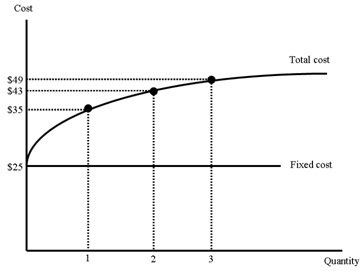
Marginal cost of the third unit of output
Problem: Given the curves shown below, the marginal cost of the 3rd unit of output is:
A) $6.00.
B) $10.00.
C) $16.00.
D) $25.00.
E) None of the above.
Now Priced at $20 (50% Discount)
Recommended (96%)
Rated (4.8/5)
Consider an organizational change that you are familiar with. Provide an evaluation of the change initiative, Answer the following questions:
Problem 1: Given the curve shown below, the marginal product of labor will be maximized at: A) 0 units of output. B) 1 unit of output. C) 2 units of output. D) 3 units of output. E) not enough information to tell.
Research how people and organizations react to change, both positive and negative. If possible, interview coworkers, family, and friends who have experienced substantial change in their lives.
three of the stereotypes shown and explain where these stereotypes come from and why they still exist.
Identify and describe 3 process skills that are necessary for the consultant to have to facilitate change.
After attending the Academic Integrity Seminar, write a reflection paper applying the Seminar to your own life.
Part WOW also can be purchased from an outside supplier at $24 per unit. If part WOW is purchased from the supplier, 40% of the fixed costs can be eliminated. If the company purchases part WOW from the outside supplier, its operating income will:
Describe the general function of performance management systems. If your assigned company does not use a performance management system, would you recommend it use one? Why or why not?
1957586
Questions Asked
3,689
Active Tutors
1429093
Questions Answered
Start Excelling in your courses, Ask a tutor for help and get answers for your problems !!
Problem: Developmental Assessments Cognitive Tests: Assessments like the Wechsler Intelligence Scale for Children (WISC)
Behavioral Checklists and Rating Scales Standardized Rating Scales: Tools like the Child Behavior Checklist (CBCL) or the Conners Rating Scales
Observation Naturalistic Observation: Clinicians observe the child in their natural environment, such as home or school, to understand their behavior in context
Adolescents (13-18 years) Techniques: Open-Ended Questions: Adolescents often respond well to open-ended questions that invite them
Middle Childhood (9-12 years) Techniques: Cognitive Assessments: Clinicians can utilize structured interviews combined with cognitive tests
Developmentally Appropriate Language: Clinicians simplify their language, avoiding jargon, and using short sentences to ensure comprehension.
Observational Techniques: Since infants may not be able to verbally articulate their feelings, clinicians often rely on observation of behaviors,