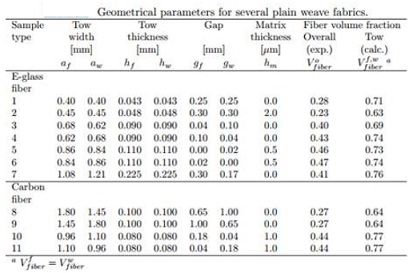
Calculate the tow elastic properties of weave
Solve the following problem:
Recalculate the tow elastic properties E1, E2, G12, G23, ν12, ν23 of weave type 1 in Table using the values of V tow f iber calculated.
Expected delivery within 24 Hours
Reflect on the discussions we have had in this class and explain how this course will help you apply theory to practice in your professional career
The effects of globalization can be seen on the commodities markets and also the equity and bond markets.
Reflection Assignment V - Hispanic and Latino Americans. Hispanic and Latino Americans, as Native Americans and African Americans comprise
Evaluate the profitability versus risk trade-offs of these three policies. Would you rate each one low, medium or high with respect to profitability?
Recalculate the tow elastic properties E1, E2, G12, G23, ?12, ?23 of weave type 1 in Table.
Do you agree or disagree with author's assessments and conclusions? Can you identify with the situations and perspectives that he presents?
Indicate how each of the following six different transactions that Dynamic Mattress might make would affect (i) cash and (ii) net working capital
How will social work grow to meet the challenges of macro practice? What skills have you acquired to engage in macro practice?
Students gain experience conducting an internal and external environmental analysis for their proposed new division and its business model.
1941393
Questions Asked
3,689
Active Tutors
1432909
Questions Answered
Start Excelling in your courses, Ask a tutor for help and get answers for your problems !!
Problem: Developmental Assessments Cognitive Tests: Assessments like the Wechsler Intelligence Scale for Children (WISC)
Behavioral Checklists and Rating Scales Standardized Rating Scales: Tools like the Child Behavior Checklist (CBCL) or the Conners Rating Scales
Observation Naturalistic Observation: Clinicians observe the child in their natural environment, such as home or school, to understand their behavior in context
Adolescents (13-18 years) Techniques: Open-Ended Questions: Adolescents often respond well to open-ended questions that invite them
Middle Childhood (9-12 years) Techniques: Cognitive Assessments: Clinicians can utilize structured interviews combined with cognitive tests
Developmentally Appropriate Language: Clinicians simplify their language, avoiding jargon, and using short sentences to ensure comprehension.
Observational Techniques: Since infants may not be able to verbally articulate their feelings, clinicians often rely on observation of behaviors,