--%>

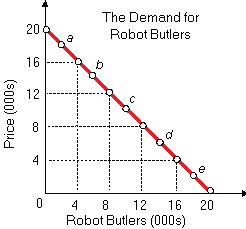
When is not total annual revenue exceeded

As per this demonstrated figure in below, unless something changes the total annual revenue of Robot Butlers, Inc. Can’t exceed: (1) $10,000. (2) $20,000. (3) $100 million. (4) $200 million. (5) $400 million.
965_Price Elasticity of Demand3.png

Can someone explain/help me with best solution about problem of Economics...

   Related Questions in Microeconomics

  • Q : When market for a good is in equilibrium

    Whenever the market for the good is in equilibrium, this signifies that the: (i) Demand and supply are equivalent. (ii) Tax wedge is perfectly offset by the government advantages. (iii) Differences among demand prices and supply prices equivalent profit per unit. (iv)

  • Q : Why production possibility curve is

    Why production possibility curve is concave? Answer: This is due to increasing the marginal opportunity cost.

  • Q : Problem on price mark up A company

    A company consists $27 per unit in variable costs and $1,000,000 annually in fixed costs. Demand is predicted to be 100,000 units annually. Determine the price if a markup of 40% on total cost is used to determine the price?

  • Q : Output produces by monopolistic

    This monopolistic competitor generates Q0 output where is: (1) MR = MC. (2) MSB > MSC. (3) average cost is not minimized. (4) P = ATC. (5) All of the above.

    Q : Effective price discrimination to

    Effective price discrimination to maximize profit does NOT needs the firm to be capable to: (w) separate the market within different groups along with different demand elasticities. (x) erect entry barriers to defend a monopoly position. (y) prevent t

  • Q : Describe "in-market" mergers Describe

    Describe "in-market" mergers?An in-market merger is one which takes place among two banks operating in the similar geographic area, normally a city or metropolitan area. The merged institution frequently ends up with more than one branch in the

  • Q : Stickiness of prices in oligopolistic

    The "kinked-demand-curve" model was developed into the 1930 year in part to help describe: (i) barriers to entry in oligopoly markets. (ii) the allegedly excessive stickiness of prices into oligopolistic industries. (iii) how competitive industries be

  • Q : Purely competition demand for labor A

    A purely competitive demand of industry for labor is: (1) less elastic than the horizontal summation of the individual firm’s demands. (2) perfectly elastic. (3) upward sloping because of diminishing marginal returns to labor. (4) equal to the h

  • Q : Consuming equal successive units of good

    The idea that additional satisfaction ultimately declines from consuming equivalent successive units of any good is the law of: (1) Consumer deficits. (2) Equivalent marginal utilities per dollar. (3) Diminishing marginal utility. (4) Veblen’s inequality. (5) Co

  • Q : Less marginal revenue then price charged

    For a nondiscriminating monopolist, there marginal revenue is: (w) profit per unit minus cost per unit. (x) total revenue per unit minus total cost per unit. (y) the modification in total revenue divided by the modification in total c