--%>

What is Primitive Type Casting

Primitive Type Casting: C/C++ allows you to cast between totally unrelated types. This can be problematic for model checking. Avoid type casting between unrelated types and in particular primitive
types. For example,
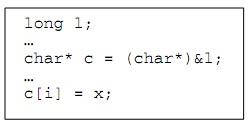
1647_primitive.jpg

Casting between unrelated types requires overhead for keeping values consistent. For primitive types, this also requires creating objects instead of primitives and explicit modeling of the memory and the platform. In languages like Java you cannot even use the immutable standard box types like java.lang.Integer. Furthermore, operations on the primitives have to be turned from direct bytecode instructions into method calls, creating more overhead.

   Related Questions in Programming Languages

  • Q : Define Continuous simulation Continuous

    Continuous simulation: In a continuous simulation, the time ticks past at a regular rate which is applicable to the specific simulation scenario. At each and every tick, all the objects in the simulation are informed of the passage of time and updated

  • Q : What is Reflection Reflection : It is

    Reflection: It is the ability to find out what fields, methods, constructors, and so forth, are stated for an object or class. Reflection is supported by the Class ‘class’, and other classes in the java.lang.reflect package. Reflection mak

  • Q : Write a recursive implementation of

    Assignment 5 Selecting Array Elements Implement the following C++ code in assembly language, using the block-structured .IF and .WHILE directives. Assume that all variables are 32-bit signed integers: int array[] = {10,60,20,33,72,89,45,65,72,18}; int sample = 50; intArraySize = s

  • Q : Homework Assignment How much would it

    How much would it cost to do a basic program within the given requirements?

  • Q : Explain Try statement Try statement :

    Try statement: The try statement performs as an exception handler - a position where exception objects are caught and dealt with. In its most common form, it comprises of a try clause, one or more catch clauses and the finally clause.

  • Q : Describe object-oriented programming

    Briefly describe object-oriented programming (OOP)?

  • Q : What is an Instantiation What is an

    What is an Instantiation: It is a creation of an instance of a class, i.e., an object.

  • Q : Explain the common uses of XML Explain

    Explain the common uses of XML.

  • Q : Explain a quality and metrics reporting

    What opinion would you provide to someone who asked you where to begin to introduce to their company a quality and metrics reporting program?

  • Q : Long lock in the tibco iProcess

    Describe the term Long lock in the tibco iProcess in brief.