--%>

What is Henry law constant and its values?

1. The units of Henry Law constant are same as those of pressure, i.e. torr or h bar.


2. Different gases have dissimilar values of Henry law constant. The values of KH for some gases in water are given in table below:

KH values of some gases in water at 298 K

Gas

kH (k bar)

Gas

kH (k bar)

H2

71.18

CH4

41.85

N2

86.78

CO2

1.67

O2

44.0

HCHO

1.83 × 10⁻⁵

Ar

40.3

CH2 = CHCl

0.611


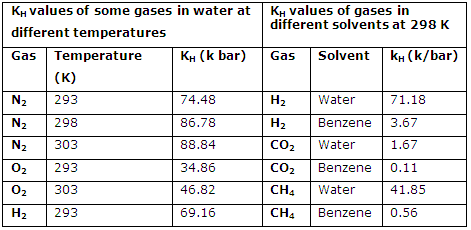
3. The KH values of a gas are different in different solvents and it increases with the increase in temperature. For example the KH values of some gases in different solvents and also at different temperatures are given in table below:

KH values of some gases in different solvents and at different temperatures:
2064_henry law.png 

4. The knowledge of KH value of a gas at given temperature can help us in calculation of its solubility at the temperature. It is important to note that as the temperature is increased the solubility of gas decreases. This implies that higher the value of KH of a gas is, lower will be its solubility and vice versa.

   Related Questions in Chemistry

  • Q : Iso-electronic species Which ion has

    Which ion has the lowest radius from the following ions(a) Na+  (b) Mg2+  (c) Al3+  (d) Si4+ Answer: (d) All are the iso-electronic species but Si

  • Q : Degree of dissociation The degree of

    The degree of dissociation of Ca(No3)2 in a dilute aqueous solution containing 14g of the salt per 200g of water 100oc is 70 percent. If the vapor pressure of water at 100oc is 760 cm. Calculate the vapor pr

  • Q : Dissolving Group IV Carbonate Explain

    Explain how dissolving the Group IV carbonate precipitate with 6M CH3COOH, followed by the addition of extra acetic acid.

  • Q : Solution and colligative properties

    what is molarity of a solution of hcl which contains 49% by weight of solute and whose specific gravity is 1.41

  • Q : F-centres If a electron is present in

    If a electron is present in place of anion in a crystal lattice, then it is termed as: (a) Frenkel defect  (b) Schottky defect  (c) Interstitial defects (d) F-centre Answer: (d) When electrons are trapped in anion vacancies, thes

  • Q : Finding Normality Can someone please

    Can someone please help me in getting through this problem. Concentrated H2SO4 has a density of 1.98 gm/ml and is 98% H2SO4 by weight. The normality is: (a) 2 N  (b) 19.8 N  (c) 39.6 N  (d) 98

  • Q : Problem on decinormal strength Can

    Can someone please help me in getting through this problem. How many grams of dibasic acid (having mol. wt. 200) must be present in 100ml  of its aqueous solution to provide decinormal strength: (i) 1g  (ii)2g  (iii) 10g  (iv) 20g<

  • Q : Electrochemistry ( electrolysis of

    1. Define Faraday's first law of electrolysis 2. define Faraday's second law of electrolysis

  • Q : Atmospheric pressure Give me answer of

    Give me answer of this question. The atmospheric pressure is sum of the: (a) Pressure of the biomolecules (b) Vapour pressure of atmospheric constituents (c) Vapour pressure of chemicals and vapour pressure of volatile (d) Pressure created on to atmospheric molecules

  • Q : Dependcy of colligative properties

    Colligative properties of a solution depends upon: (a) Nature of both solvent and solute (b) The relative number of solute and solvent particles (c) Nature of solute only (d) Nature of solvent only