--%>

What is Avoid Redundancy

Avoid Redundancy: While not every form of redundancy is as bad from a verification perspective as it is from a maintenance point of view, behavioral redundancy to re-create (local) state can impose problems because the model checker does not distinguish between function local and object state. For example:
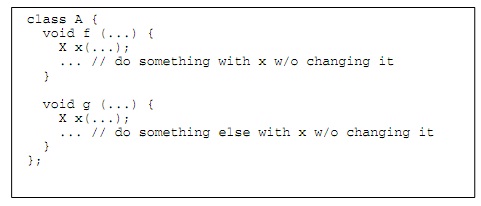
1625_redundancy1.jpg

We can change the above example by factoring out the declaration of x and turning it into object state.
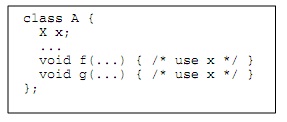
975_redundancy2.jpg

   Related Questions in Programming Languages

  • Q : Define Reserved word Reserved word : It

    Reserved word: It is a word reserved for a particular purpose in Java, like: class, int, public, and so forth. These words might not be employed as ordinary identifiers.

  • Q : Define Sign bit Sign bit : In

    Sign bit: In 2s-complement notation, the most important bit in an integer value is employed to determine the sign of the value. A 1-bit point out a negative number and a 0 bit point out a positive number.

  • Q : Distinct features of Object oriented

    Q. What are the distinct features of Object oriented programming language?  

    Q : What is an Object Object : It is an

    Object: It is an instance of a particular class. In common, any number of objects might be constructed from a class definition. The class to which an object belongs states the common characteristics of all instances of that class. In those characteris

  • Q : What is Stack overflow Stack overflow :

    Stack overflow: Stack overflow takes place whenever too many items are pushed onto a stack with a finite or limited capacity.

  • Q : Explain UpdatePanel control Briefly

    Briefly explain about the UpdatePanel control.

  • Q : What is Leverage Model-Based Design

    Leverage Model-Based Design: Model-based design provides useful hints of how a large system can be reduced so that its state space becomes searchable. If not inherently visible in the design (for example, by means of using a “State” design

  • Q : What is First in-first out First in,

    First in, first out: It is FIFO semantics of the queue data structure. Items are eliminated in the order in which they arrived in the queue; therefore older items are always eliminated before newer ones.

  • Q : Explain Multiple inheritance Multiple

    Multiple inheritance: The capability of a class or interface to expand more than one interface or class. In Java, multiple inheritance is only accessible in the circumstances which are shown below: An interf

  • Q : C-C++ interfaces into WLS JMS Normal 0

    Normal 0 false false