--%>

Weather ruins crop-equilibrium condition on supply-demand

When the soybean market is firstly in equilibrium on S0D0 and in that case severe weather ruins much of the crop, then the market moves to: (1) S1D0. (2) S1D2. (3) S2D0. (4) S2D2. (5) S1D1.
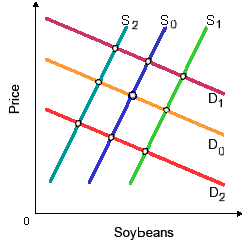
2458_soybean market in equilibrium.png

How can I solve my economics problem? Please suggest me the correct answer.

   Related Questions in Public Economics

  • Q : Lifelong objectives with utilitarian

    To be everlastingly part of an association where utilitarian principles were discussed was between the lifelong objectives of: (w) Jeremy Bentham. (x) Robert Owen. (y) Saint Simon. (z) John Stuart Mill Can someone

  • Q : Erroneous analysis LEAST attributable

    The erroneous analysis that economists seldom agree is LEAST attributable to the fact such that economists are: (w) acquire little media coverage while they agree, when disputes about how economic theory must be translated in policy a

  • Q : Purchases of recently issued bonds and

    Define one reason that the purchases of recently issued bonds and stocks: (1) just only increase the value of federal funds. (2) Are not economic investments since they are just alternative forms of people’s financial saving? (3) Reduce the prof

  • Q : Illustration of Positive and Normative

    "Minimum wage rules will reduce service of the workers they are designed to help, but they are desirable because it's more important that 90 percent of the covered workers remain employed at the higher wage than that 10 percent of the covered workers become jobless."

  • Q : Uses of positive economic analysis Hey

    Hey friends I need your help for given problem: Positive economic analysis would be least helpful like a guide to how a society can decrease: (w) specific criminal behavior from punishment. (x) inequality within th

  • Q : Explain about the term whom in

    The fundamental economic questions are "What?”, “How?”, and “For whom”? When we ask, "For whom?", we need to know who will: (w) produce the goods. (x) consume the goods. (y) get the profits. (z) decide wh

  • Q : Closest to being a free good in

    The closest to being a free good of the one given would be: (i) a scholarship for a brilliant but impoverished student. (ii) Free “meals on wheels” programs for the aged and infirm, (iii) a winning lottery ticket you determined on the side

  • Q : Theory of independence in Adam Smith era

    The Age of Enlightenment shown increased reliance upon scientific methodology and logic like mechanisms for ascertaining fact, and a growing belief which hierarchical authority lacks a monopoly upon purpose and wisdom. That school of thought set the stage for these do

  • Q : Earn zero profit in long run by

    Which of the given statements is right?: w) Economic profit takes within account all costs involved within producing a product. x) Accounting profit is not relevant within preparing the firm's financial statement. y) Economic profit all the time exceeds accounting pro

  • Q : Argument for infant industries to

    The argument for infant industries must be protected through competition through established foreign industries was first advanced through: (1) Richard List. (2) Gustav Schmoller. (3) David Ricardo. (4) Alexander Hamilton. (5) Thomas Robert Malthus. (6) early mercanti