--%>

Wage rates throughout supply of labor

For wage rates in between $18 and $21, there the elasticity of Morgan’s supply of labor is: (w) 0.72. (x) one. (y) 1.08. (z) 1.44.
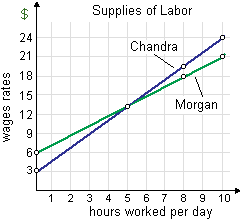
364_Labor Leisure Tradeoffs.png

I need a good answer on the topic of Economics problems. Please give me your suggestion for the same by using above options.

   Related Questions in Managerial Economics

  • Q : Total wage payments by increase in wage

    Increasing the wage from $9 to $15 will cause Plastibristle’s total hourly wage payments to: (w) rise by about $900. (x) rise by about $1500. (y) fall by about $900. (z) fall by about $1500. <

  • Q : Derived Demand for Labor All else

    All else identical, a competitive firm will demand more labor when: (w) technological advances lead to automation. (x) the price of the firm’s output rises. (y) more firms enter the industry. (z) competing firms offer their workers more training

  • Q : Elasticity of the supply possible

    When Chandra and Morgan are identically skilled and every can decide the number of hours she works as: (w) the elasticity of Morgan’s labor supply exceeds the elasticity of supply for Chandra’s labor at each possible quantity of labor. (x) Morgan’s i

  • Q : Increases in orders for new capital A

    A change in a derived demand is best demonstrated while there are increases in: (1) sales of roasted peanuts during baseball season. (2) new car sales during economic downturns. (3) orders for new capital throughout economic booms. (4) beef prices when cowboys unioniz

  • Q : Trent projection statistical method of

    Explain the Trent projection statistical method of Demand Forecasting.

  • Q : Describe the Long term Demand

    Describe the Long term Demand Forecasting.

  • Q : Income effect by personal supply of

    A personal supply of labor is exemplified by an income effect which dominates the substitution effect if: (w) Trina retires to a beach condo after working for the city for 42 years. (x) members of a rock band give up touring for a yea

  • Q : Negative Relationship in Demand for

    The demand curve for labor can be demonstrated as a negative relationship between: (w) the quantity of labor demanded and the wage rate. (x) labor productivity and the quantity of labor used. (y) employment and output. (z) wages and GDP.

  • Q : Accumulation of certificates of

    A potential employee’s accumulation of certificates and degrees to stimulate interest through a potential employer is termed by economists as: (1) specific training. (2) signaling. (3) general training. (4) screening. (5) ticket-punching. <

  • Q : Profit Maximization with Marginal

    All profit-maximizing firms will hire further labor up to the point where is the: (w) average physical product of labor equals the nominal wage. (x) last unit of labor adds equally to total revenue and total cost. (y) marginal product of labor is at i