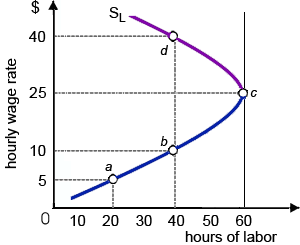
Wage rate and labor in supplying
By the following choices in this illustrated graph, this worker would be happiest at point: (w) point a. (x) point b. (y) point c. (z) point d. Please choose the right answer from above...I want your suggestion for the same.
By the following choices in this illustrated graph, this worker would be happiest at point: (w) point a. (x) point b. (y) point c. (z) point d.
Please choose the right answer from above...I want your suggestion for the same.
Please help me to solve the problem of economic that is given below: Economic capital would comprise: (w) corporate bonds. (x) money. (y) machinery. (z) sports cars. Can someone
When all markets wherein a firm operates are purely competitive, in equilibrium the marginal resource cost of labor is the same to the: (w) firm’s marginal revenue. (x) marginal cost of output. (y) wage rate the firm must pay to hire more worker
Inefficiency may exist within a labor market while a firm only hires labor up to a certain point where: (w) the value of labor’s marginal product equals the wage rate. (x) VMP > MRC. (y) MPPL = w/P. (z) the last unit of labor adds as much to
Describe the term Incremental Revenue in details.
identify two goods consumed by the majority of the neighborhood communities. Qn. establish the equilibrium of the consumers of the two goods
What are the characteristics of a business cycle?
Illustrates the relatively elastic demand?
States the determinants of elasticity?
Illustrates the Importance of managerial economics?
Illustrates about the Barometric techniques?
18,76,764
1954579 Asked
3,689
Active Tutors
1444218
Questions Answered
Start Excelling in your courses, Ask an Expert and get answers for your homework and assignments!!