--%>

Variation in demand and supply with producing cost

It shifts within the demand for new textbooks from D0 to D1 may be a result of: (1) increased enrollments of students. (2) consumers' expectations of a future increase within the price of textbooks. (3) increased literacy rates. (4) increasingly efficient E-bay auctions of used books which drove down prices for used texts. (5) an increase within the cost of producing new textbooks.
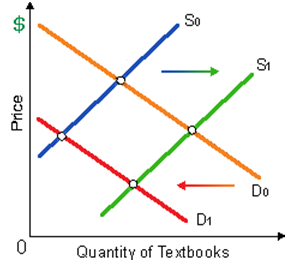
1280_demand for textbooks.png

I need a good answer on the topic of Economic problems. Please give me your suggestion for the same by using above options.

   Related Questions in Microeconomics

  • Q : Pre-tax and pre transfer income

    From 1950, the pre-tax and pre transfer income distribution comprises: (w) become more equitably distributed. (x) remained about constant. (y) become less equitably distributed. (z) moderated because the rich and the poor both lost income to the middl

  • Q : Consumption pattern matching demand

    A house-hold maximizes the satisfaction it derives from the given income by: (i) Buying lottery tickets to save more wealth. (ii) The consumption pattern which matches demand prices with the market prices. (iii) Consuming goods and hence every good is enjoyed uniforml

  • Q : Wage Rate and Exploitation problem

    Assume that a firm possessesing both monopsony power as the employer and market power in its output market, however that can neither wage neither discriminate nor price discriminate. In equilibrium, in its labor market for workers, of the given variables the lowest va

  • Q : Illustrations of Predatory Behavior

    Tactics as like [a] lowering prices, [b] expanding output beyond a short run profit maximizing level, and [c] aggressively advertising or redesigning existing products to make them incompatible along with rivals’ products are most likely to be interpreted as ill

  • Q : Minimum Supply Amounts of Resources

    Payments for a resource into excess of the minimum needed to supply specified amounts of the resource are termed as: (1) economic rents. (2) wage premiums. (3) excess profits. (4) surplus values. (5) capitalization.

    Q : When is Price Ceiling not create

    Price ceilings do NOT create pressures for: (w) shortages of price controlled goods. (x) black markets, queuing, or sales by favoritism. (y) opportunity costs to be lower than or else. (z) transactions at monetary prices below the equilibrium price.

  • Q : Demands for education in relatively

    Most college students strongly are in opposition to tuition raises. When only one student in fifty transfers to other school subsequent a ten percent tuition hike at your school, in that case your economics professor would most likely conclude that most students&rsquo

  • Q : Implication of price discrimination

    Price discrimination implies: (1) charging different prices for identical goods that have identical production costs. (2) paying wages based on race or sex quite than productivity. (3) exploiting the working masses by charging the highest single price

  • Q : Problem based on type of economy Tell

    Tell me the answer of this question. Economists would describe the U.S. automobile industry as: A) purely competitive. B) an oligopoly. C) monopolistically competitive. D) a pure monopoly.

  • Q : Short-run equilibrium and long run

    When a purely competitive industry is within equilibrium as well as all firms in the industry are operating along with economies of scale, in that case the industry is in: (w) long-run and short-run equilibrium. (x) short-run equilibrium and long run