--%>

Utility with food coupons

Question:

In Vancouver the Salvation Army encourages people to make food voucher donations to panhandlers instead of simply giving them cash. You can buy a food voucher for $5 and give it to a panhandler who can use it to purchase food. The Salvation Army says it's a way to ensure that a gift actually goes to food, rather than alcohol or drugs. Suppose a panhandler (PH) consumes two goods: food (F) and drugs (D). The PH has a utility function u = F0D1. This can also be written as u= D. Answer and explain the following using a diagram which is completely labeled.

(a) If drugs and food each cost $1 per unit, and the PH has $20 is cash, how much D and F will he consume.

(b) If instead the PH has $10 in cash and $10 in food vouchers, how much D and F will he consume?

(c) Is the PH better off with $20 in cash, or with $10 in cash and $10 in food vouchers.

Solution:

a)

u = D

PH will only consume drugs. This is because food does not give him additional utility. Whether he consumes 0 units or 1000000 units of food, it does not make a difference. Therefore, he will spend all his income on drugs. He will consume 20 units of drugs.
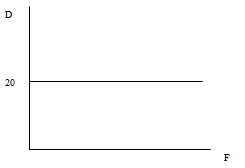
758_additional utility.png

b)

In this case, he will consume 10 units of drugs, and he is indifferent between consuming 0 units or 10 units of food.
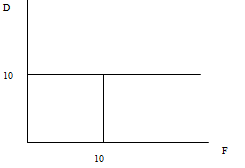
968_Utility with food coupons.png

c) Utility with $20 cash = 20

Utility with food coupons = 10

Therefore, PH is better with $20 cash.

   Related Questions in Business Economics

  • Q : Describe the Euro Describe the Euro?

    Describe the Euro?

  • Q : Speculators activities over the long-run

    Over the long-run the speculators activities are tend to: (1) decrease the volatility of prices. (2) attract legal attention and result in imprisonment. (3) increase the level and volatility of prices both. (4) yield tremendous profits and raise costs

  • Q : Define Direct and inverse relationships

    Define Direct and inverse relationships?

  • Q : Circular flow model of the private

    I have a problem in economics on Circular flow model of the private sector. Please help me in the following question. The simple circular flow model of private sector doesn’t comprise: (i) Firms. (ii) Product markets. (iii) Government agencies.

  • Q : Equilibrium market rate & Undervalued

    Question: a. In the short-run, it is easier for a country to maintain a peg that undervalues a currency (relative to the equilibrium market rate) than it is to maintain a peg that overvalues the currency (relative

  • Q : Higher opportunity costs of attendance

    Economics professors would attribute students’ higher rates of attendance on days while examinations are administered to the: (w) intensified needs to learn valuable material. (x) higher opportunity costs of missing set relative to other schedul

  • Q : Comparative advantage in production I

    I have a problem in economics on Comparative advantage in production. Please help me in the following question. The oranges are grown in Florida and potatoes are grown in Maine mainly since: (i) orange-grower’s in Maine have not lobbied effectiv

  • Q : Market efficiency while transaction

    Transaction costs tend to be decreased and markets are more efficient when: (w) the government subsidizes a good. (x) inter-market price differentials are eliminated through arbitrage. (y) taxes are used to give for social wants. (z) regulations close

  • Q : Market structure and pricing decision

    Just need help to see if I am in the right direction if there any think wrong need help with it.

  • Q : Describe GDP gap and Okun’s Law

    Describe GDP gap and Okun’s Law?