--%>

Use the NW corner rule to find an initial BFS


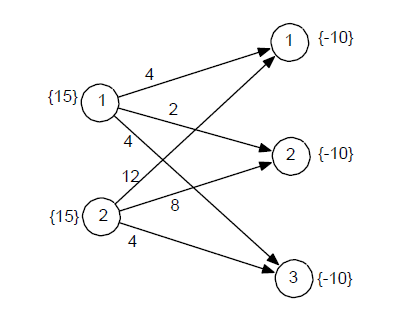
(a) Use the NW corner rule to find an initial BFS, then solve using the transportation simplex method. Indicate your optimal objective function value.

(b) Suppose we increase s1 from 15 to 16, and d3 from 10 to 11. Show that even though an extra unit is being shipped, the total shipping cost actually decreases by $2. Explain why increasing both supply and demand has resulted in a decreased solution cost by relating this phenomenon to the dual variables associated with supply node 1 and demand node


1825_Transportation_Problem.png

   Related Questions in Basic Statistics

  • Q : Quantities in a queuing system

    Quantities in a queuing system: A: Count of

  • Q : Report on Simple Random Sampling with

    One of my friend has a problem on simple random sampling. Can someone provide a complete Report on Simple Random Sampling with or without replacement?

  • Q : Explain Queuing theory Queuing theory :

    Queuing theory: • Queuing theory deals with the analysis of lines where customers wait to receive a service:

    Q : Stats The College Board SAT college

    The College Board SAT college entrance exam consists of three parts: math, writing and critical reading (The World Almanac 2012). Sample data showing the math and writing scores for a sample of twelve students who took the SAT follow. http://west.cengagenow.com/ilrn/books/assb12h/images/webfiles/

  • Q : Define Utilization Law Utilization Law

    Utilization Law: • ρk = XK . SK = X . DK • Utilization of a resource is the fraction

  • Q : Cumulative Frequency and Relative

    Explain differences between Cumulative Frequency and Relative Frequency?

  • Q : Statics for each of the following

    for each of the following studies a and b decide whether to reject the null hypothesis that groiups come from identical populations. Use the .01 level. (c) Figure the effects size for each study. (d) ADVANCED TOPIC: Carry out an analysis of variance for study (a) using the strucurtal method.

  • Q : Model Checking Approach Model Checking

    Model Checking Approach: • Specify program model and exhaustively evaluate that model against a speci?cation        –Check that properties hold   

  • Q : Creating Grouped Frequency Distribution

    Creating Grouped Frequency Distribution: A) At first we have to determine the biggest and smallest values. B) Then we have to Calculate the Range = Maximum - Minimum C) Choose the number of classes wished for. This is generally between 5 to 20. D) Find out the class width by dividing the range b

  • Q : Safety and Liveness in Model Checking

    Safety and Liveness in Model Checking Approach; •? Safety: Nothing bad happens •? Liveness: Something good happens •? Model checking is especially good at verifying safety and liveness properties    –?Concurrency i