--%>

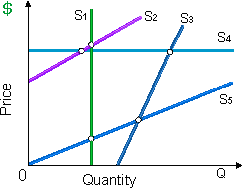
Unitarily price elastic supply for quantities and prices

Supply is unitarily price elastic for all quantities and prices upon: (i) supply curve S1. (ii) supply curve S2. (iii) supply curve S3. (iv) supply curve S4. (v) supply curve S5.
1429_Price Elasticity of Supply1.png

I need a good answer on the topic of Economics problems. Please give me your suggestion for the same by using above options.

   Related Questions in Microeconomics

  • Q : Price below perfect competition Who

    Who decides price beneath perfect competition? Answer: Price under perfect competition is recognized by the forces of market demand and supply in business.

  • Q : Profits and Losses-Natural selection

    The Natural selection theory states that the manager’s failures to maximize the profits cause: (i) Firing of its managers. (ii) The firm’s collapse. (iii) Outside take-overs. (iv) All of the above. Can someone please he

  • Q : Normal accounting profits in monopoly

    This monopoly makes Q units and experiences as: (1) economic profits equal to 0cbQ. (2) economic losses equal to cpab. (3) more than normal accounting profits. (4) marginal cost in excess of average total cost. (5) total revenue less than total cost.<

  • Q : A monopolist in market power A

    A monopolist: (w) is a price taker in the sale of its product. (x) can charge any price this wishes without reducing profit. (y) is not a price taker into the sale of its product. (z) may or may not be a price taker within the sale of its product.

  • Q : Inadequate competition or lack of

    A firm’s capability to alter the price of its output due to inadequate competition or a lack of perfect substitutes for its products is an illustration of: (i) adverse selection. (ii) simple game theory. (iii) X-inefficiency. (iv) strategic behavior. (v) market

  • Q : Define excess demand Excess demand : If

    Excess demand: If AD > AS at the full employment level. Then it is termed as Excess demand.

  • Q : Change in total revenue by selling

    Marginal revenue, which is: (w) the change in total revenue from selling an additional unit of output. (x) the change in total revenue from hiring an additional unit of labor. (y) computed as TR/Q. (z) specified by change in Q / change in TR.

  • Q : Marginal revenue in selling extra unit

    The price a firm acquires from selling an extra unit of output, minus any revenue lost when price should be reduced in all other units sold, equals: (1) average revenue. (2) marginal profit. (3) mark-up price. (4) marginal revenue. (5) total revenue.<

  • Q : Freedom of entry in monopolistically

    Along with freedom of entry in a monopolistically competitive market, in long run equilibrium is reached along with firms: (w) earning zero economic profit. (x) producing where price equals marginal cost. (y) producing their most efficient output. (z)

  • Q : Profit maximizing strategy at breakeven

    Nostalgia Corporation would exactly break-even on its Silver Screen DVDs when, in place of correctly identifying its profit maximizing strategy, this: (w) operated at point i, charging only $10 per DVD and producing 8 million DVD. (x)