--%>

Unitarily elasticity in supply curve

At point b, in demonstrated figure the supply curve into this graph is: (w) perfectly elastic. (x) elastic, but not perfectly that why. (y) unitarily elastic. (z) inelastic.
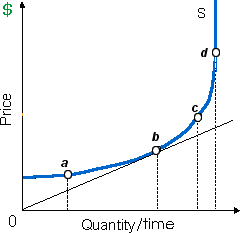
327_Price Elasticity of Supply3.png

Can anybody suggest me the proper explanation for given problem regarding Economics generally?

   Related Questions in Microeconomics

  • Q : Shutdown point of monopoly firm A

    A monopoly firm must shut down in the short run when: (w) P < minimum [average total costs [ATC]]. (x) P > minimum [average total costs [ATC]]. (y) this cannot cover all variable costs. (z) P does not equal marginal costs [MC].

    Q : Price elasticities of demand and higher

    Price elasticities of demand tend to as: (i) fall as higher prices are charged. (ii) rise as higher prices are charged. (iii) almost always be constant. (iv) not be associated to the length of time. (v) not be influenced by price changes.

  • Q : Higher price at slope of the demand

    When the slope of the demand for wheat is ten, we can predict now that a higher price of wheat will be as: (w) increase total expenditures on wheat. (x) reduce total expenditures on wheat. (y) not influence total expenditures on wheat. (z) More information is required

  • Q : Characterized monopolistic competition

    Within the long run a monopolistically competitive firm will not be characterized through: (w) zero economic profit. (x) price greater than marginal revenue. (y) production at lowest possible average total cost. (z) price greater than marginal cost.

  • Q : Alpha's and Beta's profits Refer to the

    Refer to the below diagram where the numerical data illustrates profits in millions of dollars. Beta's profits are illustrated in the northeast corner and Alpha's profits in the southwest corner of each cell. If Alpha and Beta engage in collusion, the outcome of the g

  • Q : Natural barrier to entry in monopolizes

    The Diamante Corporation is vast and owns the world’s merely red diamond mine. Thus diamante monopolizes the market for red diamonds, and this is protected by competition by a: (1) regulatory barrier to entry. (2) strategic barrier to entry. (3) natural barrier

  • Q : Normative Standards for Distribution

    Relative to a requirements standard for distributing income, in that case the adoption of an equality standard would most likely tend to be: (w) unarguably fairer. (x) less bureaucratic. (y) more harmful to work incentives. (z) clearly less fair.

  • Q : Kinked Demand by decreasing price In

    In this kinked demand curve model as in given graph, when this firm operated at point a and lowered its price by P2 to P1 and other firms in the industry also lower prices, in that case this firm will move from point a to: (w) po

  • Q : Concept of Production Possibilities

    The Production possibilities frontiers describe the concepts of: (1) A trade-off between inflation and unemployment. (2) Positive economics versus the normative economics. (3) Scarcity, opportunity costs, and reducing returns. (4) Absolute advantages

  • Q : Value of the Average Product Hulk is

    Hulk is the fitness counselor who coaches 5 clients at a time in the exercise groups at Beefcake Body Builders. His hourly salary is $17, and Beefcake charges Hulk’s clients $20 for each and every hour-long conditioning session. Average value of the product Hulk