--%>

Unexpected inventory growth of price

These supply and demand curves within the sugar market specify that: (w) a price floor of P0 for sugar will cause a surplus. (x) a price ceiling of P2 will cause a shortage. (y) the market clears while quantity equals Q0. (z) at P2, unexpected inventory development will push price towards P0.
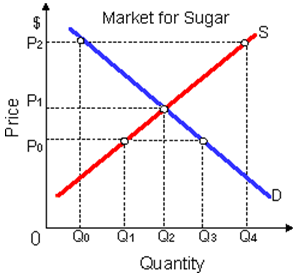
406_example of Equilibrium.png

Hello guys I want your advice. Please recommend some views for above economics problems.

   Related Questions in Microeconomics

  • Q : Determine profit maximizing price The

    The profit-maximizing price for copyrighted smash-hit St. Valentine’s Day software of Prohibition Corporation is: (i) $12 per copy. (ii) $20 per copy. (iii) $24 per copy. (iv) $32 per copy. (v) $40 per copy. <

  • Q : Non-discriminating firm through

    The non-discriminating organization with monopsony power in the labor market confronts the: (i) Wage rate which consistently surpasses the marginal revenue. (ii) MRP less than w. (iii) MFC which surpasses w. (iv) Monopolistic seller of the organization’s output.

  • Q : Reliablity with standard economic

    Which of the given behaviors is least reliable with standard economic suppositions regarding consumer behavior? (i) Gustav cannot decide which of three distinct combinations of goods he favors. (ii) Lynn hates pickled herring; however Chris is willing

  • Q : Ultimate lenders and borrowers

    Financial intermediation is a process wherein financial institutions: (w) incur substantial outflows of funds. (x) facilitate financial flows by eventual lenders to eventual borrowers. (y) face rigid reserve requirement ratios. (z) experience "runs" w

  • Q : Problem on monoplists Suppose that the

    Suppose that the total cost curve for a monopolist is provided by TC = 3y2 + 800 and its marginal cost curve is given as MC = 6y.  Also assume it faces a market demand curve of py = 280 - 4y and marginal revenue curve of MR = 280 – 8y.

  • Q : Relative profitability and efficiencies

    From around 1890 until 1970 year, the “structure-conduct-performance paradigm” dominated theories concerning how firms behave in various types of markets. Here the word “performance” in this context consider to things as: (i) d

  • Q : Influences on union nonunion wage

    Significant influences on union non-union wage differentials comprise the: (1) Proportion of an industry which is unionized and the frequency of strikes. (2) Frequency of strikes, inflation and the collective bargaining policies. (3) Collective bargai

  • Q : Total revenue of monopolistically

    A particular monopolistically competitive firm’s total revenue is probably to increase when this: (w) increases the prices of its products and consumer demand is elastic. (x) maintains its original price even if all of its compe

  • Q : Product differentiation in conduct

    Several market structures may pivot around goods which are heterogeneous, however the only market structure that absolutely needs goods to be differentiated within the minds of consumers of: (1) perfect competition. (2) pure competition. (3) monopolistic competition.

  • Q : State microeconomic Choose

    Choose microeconomic statement from following A) The real domestic output increased by 2.5 percent last year. B) Unemployment was 6.8 percent of the labor force last year. C) The price of personal computers declined last year. D) The general price level increased by 4