--%>

Under negative income tax the net income

Under the negative income tax system demonstrated in this figure, where a family of four all along with earned income of $60,000 yearly would have a net [after-tax] income of: (1) $37,500 per year. (2) $42,500 per year. (3) $50,000 per year. (4) $55,000 per year. (5) $60,000 per year.
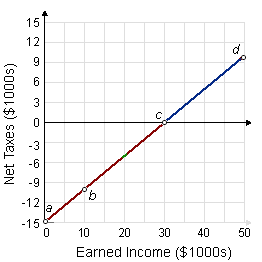
1122_Negative Income Tax Problem.png

How can I solve my Economics problem? Please suggest me the correct answer.

   Related Questions in Microeconomics

  • Q : What is production function Production

    Production function: It is the technological relationship among input and output of a firm and is termed as production function.

  • Q : Divide future income by one plus

    To discount income which will be received in one year from the interest rate, we: (w) multiply the future income by the interest rate. (x) divide the future income by the interest rate. (y) divide the future income by (1 + the interes

  • Q : Estimate price cross-elasticities of

    When the prices rise of Comfort shoes rise through two percent, causing Wonder sock sales to fall through six percent, these goods are _____, and _____ is about the cross price elasticity of demand. (1) luxuries;  6. (2) necessities; 2. (3) subst

  • Q : Demand curves relatively more elastic

    Scrutiny of demand curves DD and D0D0 reveals such that: (1) D0D0 is relatively more elastic at a price of P1. (2) DD is relatively more elastic at a price of P2. (3) D0D0 probably reflects the demand f

  • Q : Problem regarding to trade restrictions

    When the U.S. imposes quotas which restrict imports of textiles from China, this decrease the: (w) demand for textiles within the U.S. (x) supply of Chinese textiles to Europeans. (y) supply of textiles in the U.S. (z) incomes of U.S. textile makers.

    Q : Negative slope of market-Law of demand

    I have a problem in economics on Negative slope of market-Law of demand. Please help me in the following question. The negative slope of the market demand curves for normal goods areleast persuaded by: (i) Diminishing marginal utility.  (ii) Inco

  • Q : Distribution of income in a purely

    For a specified distribution of income within a purely competitive economy, marginal social benefit will the same marginal social cost unless: (w) “hit and run” entrepreneurs prosper. (x) economic profits

  • Q : Relative profitability and efficiencies

    From around 1890 until 1970 year, the “structure-conduct-performance paradigm” dominated theories concerning how firms behave in various types of markets. Here the word “performance” in this context consider to things as: (i) d

  • Q : Question on Demand-Supply curves Assume

    Assume that the market for cigarettes in a specific town has the given supply and demand curves: QS = P; QD = 50 − P, here the quantities are evaluated in thousands of units. Assume that the town council requires raising $300,000 in revenue

  • Q : Justified investment by paying income

    When the price of each of the given assets is $10,000 and the interest rate is 10%, then investment is most justified for: (1) a perpetuity paying $900 annually. (2) a machine with a 3 year life which can be leased to an outsider for $10 per day. (3) an income stream