--%>

Total wage payments by increase in wage

Increasing the wage from $9 to $15 will cause Plastibristle’s total hourly wage payments to: (w) rise by about $900. (x) rise by about $1500. (y) fall by about $900. (z) fall by about $1500.
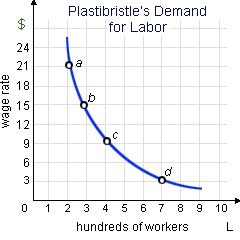
511_Elasticity of the Demand for Labor problem.png

How can I solve my Economics problem? Please suggest me the correct answer.

   Related Questions in Managerial Economics

  • Q : Explain the role of demand factor in

    Explain the role of demand factor in pricing briefly.

  • Q : Depression - Phases of business cycle

    Illustrates the term dispersion of phrases of business cycle?

  • Q : State Extrapolation statistical Method

    States the Extrapolation statistical Method of Demand Forecasting?

  • Q : Competitive Profit Maximization in

    A profit-maximizing competitive firm hiring by a competitive labor market will be within equilibrium where is: (w) MPP = MRC. (x) w = MRC. (y) VMP = MPP. (z) VMP = w. Hey friends please give your o

  • Q : Value of the Marginal Product and

    When a firm is a price taker in the sale of its product, in that case labor’s: (w) ARP (Average Revenue Product) = MRP. (x) ARP = VMP. (y) VMP > MRP. (z) VMP = MRP. Can someone explain/help me with best so

  • Q : Elasticity of Demand for Labor in Firm

    Increasing the wage rate increases total wages received through workers when the demand for labor is: (w) relatively elastic. (x) relatively inelastic. (y) unitarily elastic. (z) perfectly elastic.

  • Q : Unitarily inelastic supply of labor

    Glynn’s supply of labor is unitarily inelastic while the wage rate increases by: (1) $10 per hour to $20 per hour. (2) $10 per hour to $50 per hour. (3) $20 per hour to $50 per hour. (4) $20 per hour to $80 per hour. (5) $80 per hour to $90 per

  • Q : Case Study I am uploading another

    I am uploading another project. Please provide cost and estimated delivery day. Thanks.

  • Q : Decline in equilibrium marginal revenue

    Declines within the equilibrium marginal revenue product of a firm’s workers are probably to follow the adjustments to: (1) increases in specific training. (2) decreases in the wage rate. (3) increases in the demand for output. (4) hikes in the

  • Q : Dependency of labor supplies Labor

    Labor supplies depend on wage rates and also: (w) labor force participation and capital availability. (x) worker skills and preferences regarding employment. (y) technology and the price of output. (z) labor force participation and derived demand.