--%>

Total variable costs of profit-maximizing competitive firm

This profit-maximizing competitive firm’s total variable costs or TVC as in illustrated figure can be computed area as: (i) 0P3fq4. (ii) P2P1de. (iii) P3P2ef. (iv) 0P2eq4. (v) aced.
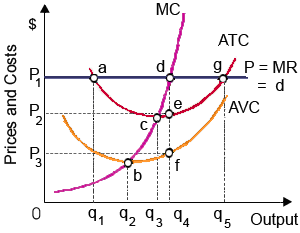
217_Total Revenue1.png

Please guys help to solve this problem of Economics with some explanation.

   Related Questions in Microeconomics

  • Q : Best illustration of an oligopoly The

    The best illustration of an oligopoly is: (1) guaranteed next-day delivery of packages and mail. (2) cranberry production. (3) all the local electric utility companies in New England. (4) the United Autoworkers [UAW] union. (5) Wal-Mart.

  • Q : Standard economic reasoning for price

    In the given figure as in below, demand curve D0D0: (w) has price elasticity of infinity. (x) is possibly for a luxury good. (y) is unitarily price elastic. (z) seems contrary to standard economic reasoning.

    Q : Oligopoly and Economic Welfare Assume

    Assume that P = MSB and the firms in an oligopoly are in equilibrium where P>MC. This follows that: (1) P=MSC. (2) MSB>MSC. (3) MSB<MSC. (4) oligopolists will gain zero economic profit. (5) the minimum point on the LRATC curve will achieved i

  • Q : Subsidies on a good for buyers and

    Government subsidies on a good because of: (w) less of the good to be produced and purchased. (x) prolonged excess demands for the good. (y) buyers to pay lower prices, when sellers receive higher prices. (z) prolonged shortages of the good.

  • Q : Factors establishing elasticity of

    Factors establishing elasticity of supply: The factors below will persuade the elasticity of supply: 1. Modifications in cost of production. 2. Behavior pattern of producers. 3. Accessibility of faci

  • Q : Problem on Advocacy of maximizing

    Advocacy of maximizing happiness for huge number of people is a hallmark for: (a) Monarchy. (b) Laissez faire capitalism.  (c) Utilitarianism. (d) Communism. (e) Democratic socialism. Find out the right answer from the above options.

  • Q : Average variable cost at price of

    A monopoly facing a demand curve which has segments higher than its average variable cost curve that sets price: (w) equal to MR. (x) equal to marginal costs [MC]. (y) from the market demand curve after finding the quantity where is m

  • Q : Effective price discrimination

    Effective price discrimination does NOT need a firm to: (w) segment the market into groups along with various demand elasticities.  (x) be a monopoly. (y) prevent trading among customers who are charged different prices. (z) possess some market p

  • Q : Explain facing horizontal line by

    When the demand curve facing a firm is a horizontal line, then there demand is perfectly: (w) elastic at each quantity. (x) inelastic where quantity demanded is zero. (y) insensitive to the price of good. (z) unresponsive to changes within the prices

  • Q : Monopolistically competitive firm at

    Unlike a firm within purely competitive long run equilibrium, within the long run, there a monopolistically competitive firm which does not price discriminate: (w) produces where P = MC. (y) does not price at the bott