--%>

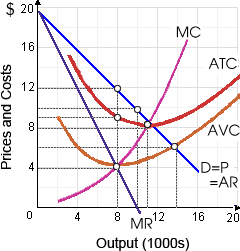
Total variable cost when maximizes economic profits

Total variable cost when this firm maximizes economic profits would be: (i) $12,000 per period. (ii) $24,000 per period. (iii) $32,000 per period. (iv) $48,000 per period. (v) $60,000 per period.
138_Price Discrimination.png

Hey friends please give your opinion for the problem of Economics that is given above.

   Related Questions in Microeconomics

  • Q : Process of Capitalization

    Capitalization is a process which converts: (1) natural resources into economic capital. (2) predictable income flows within wealth. (3) the opportunity cost of capital into the market interest rate. (4) financial capital into economic investment. (5)

  • Q : Classical adjustment in capital markets

    The first plans of savers and investors within this closed private economy are demonstrated as S0 and I0. Assume that people begin spending less on current consumption, and total saving plans shift to curve S

  • Q : Market demand in short run purely

    Ceteris paribus, inside the short run an increase into the market demand for this product would permit this purely competitive firm to be: (w) make only normal profits. (x) break even. (y) make economic profits, although not in the long run. (z) compe

  • Q : Long run and short run costs I have

    I have difficulty in this question. Provide me correct solution of this to submit my assignment. What is the relationship among long run and short run costs?

  • Q : Why demand curve face monopolistically

    Why is demand curve facing a monopolistically competitive firm probable to be very elastic?

  • Q : Price floor for Whopper Slushees The

    The government price floor for Whopper Slushees at P3 would result a: (i) shortage of Q1 – Q3. (ii) Excess of Q3 - Q1. (iii) Supply price of P1. (iv) Quantity demanded of Q2. (v) Demand price of P2.

    Q : Problem related to aggregate demand

    Refer to the below diagram, in which Qf is the full-employment output. If aggregate demand curve AD1 describes the current situation, appropriate fiscal policy would be to: A) increase taxes and reduce government spending to shift the aggregate d

  • Q : Substitution Effect-decreasing

    The substitution effect is negative since people react to a price raise by: (i) Reducing purchases of good. (ii) Generating more of good. (iii) Purchasing some substitute goods. (iv) Working less to sustain the existing purchasing patterns.

    Q : Changes in Bonds and Interest Rates

    When you buy a bond if the interest rate is 10% and sell this while the interest rate is 15%, in that case you will receive: (w) less than you paid for the bond. (x) more than you paid for the bond. (y) the same amount which you paid for the bond. (z)

  • Q : More willing to hold less cash and more

    When households become more willing to hold less cash and more stocks or bonds, in that case the: (1) level of Aggregate Demand increases. (2) present value of future income falls. (3) interest rate falls. (4) stock market will crash.