--%>

Total revenue of profit maximizing firm

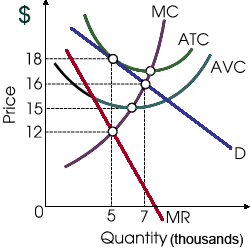
If this profit-maximizing firm as in given figure can’t price discriminate, in that case its total revenue will equal to: (w) $90,000 per month. (x) $112,000 per month. (y) $60,000 per month. (z) $120,0000 per month.
1683_Monopolistic Competition1.png

Can someone explain/help me with best solution about problem of Economics...

   Related Questions in Microeconomics

  • Q : Problem of tax on a good I have a

    I have a problem in economics on Problem of tax on a good. Please help me in the following question. The tax on a good tends to form: (1) A wedge between the price buyers pay and the price sellers collect. (2) Rises in supply from the perspectives of buyers. (3) More

  • Q : Relationship between MPC and MPS

    Determine relationship between MPC and MPS? Answer: MPC + MPS = 1

  • Q : Competitive Markets and Labor unions I

    I have a problem in economics on Competitive Markets-Labor unions. Please help me in the following question. The purely competitive labor markets are not characterized through: (1) Most of the individual buyers and sellers of the labor services. (2) S

  • Q : Innovating and enduring uncertainty of

    Profits are: (i) rewards for innovating and enduring uncertainty. (ii) economic, not normal, under pure competition. (iii) reduced through monopolistic business practices or structure. (iv) payments for providing capital. (v) payments to resource owne

  • Q : Saving and the Supply of Loanable Funds

    The principal eventual lenders/savers within financial markets are: (w) business firms. (x) the government. (y) households. (z) foreign investors. I need a good answer on the topic of Economics pro

  • Q : Supply curves toward right from

    Technological progress shift: (i) Demand curves up and to right. (ii) Production possibilities curve in the direction of their origins. (iii) Prices into inflationary spiral. (iv) Supply curves rightward from vertical axis. Can som

  • Q : Problem on Decisions at the Marginal

    The least clear illustration of how decisions are generally at the margin would be: (i) A floral shop hiring an additional clerk and opening earlier in hopes of increasing revenues by half. (ii) Eating less whenever the menu is a-la-carte than at an ‘all-you-can

  • Q : Constant shortages of a good problem

    Constant shortages of a good are nearly always attributable to: (1) legal ceiling prices which are set beneath equilibrium. (2) Recessions which yield maximum unemployment rates. (3) Price gouging by firms through monopoly power. (4) Legal price floor

  • Q : Public utilities in natural monopoly

    Public utilities are generally: (1) regulated natural monopolies. (2) competitive non-profit corporations. (3) consequences of diseconomies of scale in production. (4) only subject to laissez-faire regulation. (5) operated by the federal government.

  • Q : Separation of the Economic Functions

    Separation of ownership or stockholders by control (management) into modern giant corporations tends to divide the economic functions of: (w) capitalists. (x) union leaders. (y) entrepreneurship. (z) bureaucrats. I