--%>

Total revenue in profit-maximizing competitive firm

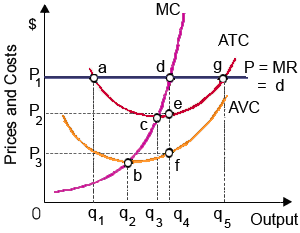
Total revenue (i.e., TR=PQ) for such profit-maximizing competitive firm equals area as: (a) 0P1gq5. (b) 0P1dq4. (c) 0P2cq3. (d) P2P1de. (e) 0P2eq4.
37_Total Revenue1.png

I need a good answer on the topic of Economics problems. Please give me your suggestion for the same by using above options.

   Related Questions in Microeconomics

  • Q : Technological advances in natural

    Natural barriers to entry may be overcome across time from: (w) cut-throat competition. (x) elimination of patent laws. (y) technological advances. (z) rigorous enforcement of antitrust laws. How can I solve my

  • Q : Monopolistic Exploitation dilemma In

    In equilibrium for the price maker firm, the rate of monopolistic exploitation is the difference between: (p) P and MR. (q) P and MC. (iii) Total revenue and net cost per unit of output. (r) Output price and rate of monopsonistic exploitation. (s) VMP and MRP.

  • Q : Emerging by price discrimination

    Oligopolies are least expected to emerge due to: (1) economies of scale. (2) price discrimination. (3) strategic barriers to entry. (4) mergers. (5) legal barriers to entry. Can anybody suggest me the proper explan

  • Q : Marginal cost curve in market power

    Above the minimum average variable cost curve, the marginal cost curve is not the supply curve of a monopoly since, unlike purely competitive firms, firms along with market power: (w)

  • Q : Make capital available to society

    Savers who in that way make capital available to society are rewarded along with economic: (1) interest. (2) capital gains. (3) perpetuities. (4) profits. (5) rent. How can I solve my Econo

  • Q : Demand curve for software upgradation

    Microsoft charges a substantially lower price for a software upgrade than for the initial purchase of the software. This implies that Microsoft views the demand curve for the software upgrade to be: A) more elastic than the demand for the original software. B) upslop

  • Q : Quantity demanded and goods price The

    The law of demand defines that there is a negative relationship among: (1) A good’s price and quantity demanded. (2) Limitless demands and inadequate resources. (3) The quantities demanded and supplied. (4) People’s income and demands for

  • Q : Supply of labor in perfectly

    Supply of labor in perfectly competitive market

  • Q : Instance Diminishing Marginal Utility

    Assume that you were permitted to eat as many ‘free’ jelly beans as you want at present. Subsequent to a few, you start to eat more slowly and to select some flavors over others. You might ultimately stop eating a ‘free’ and enjoyable good sinc

  • Q : Capital Goods In the above diagram, the

    In the above diagram, the elimination of discrimination is best represented by