--%>

Total revenue and profit

Monsieur Cournot has a monopoly on an artesian well from that flows tasty spring water along with medicinal properties. To ignore variable costs, he insists which customers bring their own pails as well as fill them personally. When Cournot could completely price discriminate, in that case his total revenue and profit could equal as: (1) 12,000 Euros. (2) 20,000 Euros. (3) 27,000 Euros. (4) 36,000 Euros. (v) 144,000 Euros.
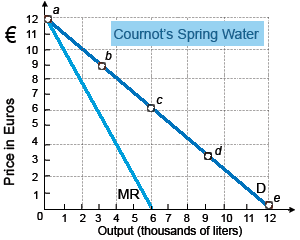
2072_Elasticity and Total Revenue.png

Please help me to solve the problem of Economic that is given above.

   Related Questions in Microeconomics

  • Q : Provision of employment opportunities

    Government attempts to decrease poverty in the United States have comprised: (1) the provision of employment opportunities. (2) strong reliance on the negative income tax. (3) elimination of all taxes on the poor. (4) rising federal expenditures for m

  • Q : Industrial Unions-specific industry Can

    Can someone help me in finding out the right answer from the given options. The industrial union is intended to cover all the workers who: (1) Encompass a specific skill. (2) Are in a specific industry. (3) Encompass experience as apprentices. (4) Work merely on assem

  • Q : Monopsonistic Exploitation-Wage

    Whenever a firm's wage structure imitates the keenness of individual employees to work, terms which are most applicable comprise: (1) Monopsonistic exploitation and the wage discrimination. (2) Monopolistic exploitation and the separation of control and ownership. (3)

  • Q : Determine present value by interest rate

    When the annual interest rate is 12 percent and a rental house can be expected to rent perpetually for price of $1,000 monthly, in that case the house has a present value of approximately: (1) $240,000. (2) $144,000. (3) $100,000. (4) $72,000. (5) $12

  • Q : Quantity demands equivalent quantity

    These supply and demand curves for sugar propose that the: (1) demand price exceeds the supply price at quantity Q2. (2) technology should advance to allow output to develop to Q4. (3) quantity demanded equals quantity supplied at P1.

  • Q : Lowest possible price in transaction

    Is the assertion such that "Everyone all the time buys everything at the lowest possible price" right? Have you paid more than you had to for any good yet, after permitting for all transaction costs?

  • Q : Competitive Prices for selling This

    This purely-competitive producer’s generic bricks presently sell for: (i) $60 per thousand. (ii) $70 per thousand. (iii) $80 per thousand. (iv) $90 per thousand. (v) $100 per thousand.

    Q : Differentiate pure competition and

    The difference among pure competition and monopolistic competition is which: (w) monopolistic competitors generate more profit in the long run. (x) monopolistic competitors always ignore short term losses. (y) long run entry and exit is probable in pu

  • Q : Theory of microeconomic game in market

    The theory of market structure which several microeconomic game theorists were ready to toss within the dustbin of intellectual history into the 1970 year but that, in the early 1980s, turned into a foundation for the “new&rdquo

  • Q : Wage Discrimination problem Both level

    Both level of the employment by a firm and the average rate of monopsonistic exploitation of labor are raised when a firm is capable to: (1) Outsource by hiring low productive workers in the foreign countries. (2) Replace the workers with automation by an industrial r