--%>

Total costs from maximizes profit

If this firm maximizes its profit as in given graph, then its total costs equal: (w) $75,000 per month. (x) $90,000 per month. (y) $15,000 per month. (z) $105,000 per month.
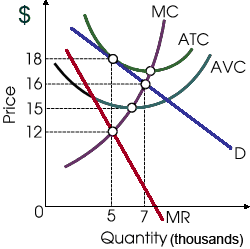
2492_Monopolistic Competition1.png

Can anybody suggest me the proper explanation for given problem regarding Economics generally?

   Related Questions in Microeconomics

  • Q : Problem on market demand for chewing gum

    The market demand for the chewing gum is as: QG = 300 – 40PG – 8PS + 0.05IHere:QG = Quantity of gum demandedPG = price of gumPS = price of sodaI = average inc

  • Q : Price elasticity of demand for pizza

    Since the price drops/falls from $8 to 1 all along this demand curve, the price elasticity of demand for pizza: (1) increases towards infinity. (2) Drops/Falls towards zero. (3) Increases, then drop/falls. (4) Always equivalents 1 and demand is unitar

  • Q : Negative GDP gap A large negative GDP

    A large negative GDP gap implies: A) an excess of imports over exports. B) a low rate of unemployment. C) a high rate of unemployment. D) a sharply rising price level.

  • Q : Collective Bargaining-managers and

    The strikes tend to be resolved after worker’s savings trickle down to a discomfort region and there is an exhaustion of: (i) Public tolerance, causing government to set the fair settlement. (ii) Managers and inventories, causing the firms to increase their offe

  • Q : Define Indirect taxes Indirect taxes :

    Indirect taxes: Whenever the liability to pay tax is on one person and the burden of that tax falls on another person, it is termed as indirect tax. Illustrations are: sales tax, excise duty, VAT, tax on services and so on.

  • Q : Social Welfare and Value of Marginal

    I have a problem in economics on Social Welfare and Value of Marginal Product of Labor. Please help me in the following question. The social value of additional output from the additional units of labor is: (i) Marginal revenue of the product of labor

  • Q : Legal barriers to entry Patents are

    Patents are illustrations of: (a) legal economies of substitution. (b) legal barriers to entry. (c) natural barriers to entry. (d) marginal diseconomies of scale. Can someone explain/help me with best solution about problem of

  • Q : Ecomomics Which one of the following

    Which one of the following statements about discretionary fiscal policy is correct? A. Discretionary fiscal policy refers to changes in taxes and government expenditures made by Congress to stabilize the economy. B. Discretionary fiscal policy refers to any change in government spending or taxes

  • Q : Total revenue for profit-maximizing

    TR (total revenue) for this profit-maximizing pure competitor equivalents area: (i) 0PeQ. (ii) bPec. (iii) aPed. (iv) 0bcQ. (v) 0Pec.

    Q : Labor Unions and Aggregate salary Income

    The least probable outcome when unions succeed in increasing their member’s salaries is that: (1) Wages in non-union sectors will drop. (2) Employment will produce in non-union sectors. (3) Barriers will be building up to limit the entry to unions. (4) Labor's s