--%>

Total costs by charges profit-maximizing price

When LoCalLoCarbo produces the profit-maximizing quantity and charges the profit-maximizing price, in that case its total costs equal the area of the rectangle as: (i) 0P3cq2. (ii) bdP4P1. (iii) 0P4dq2. (iv) bcP3P1. (v) 0P2fq4.
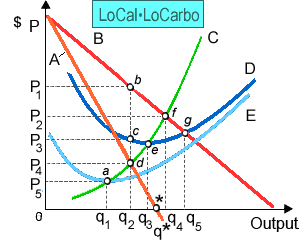
1410_Market Power and Marginal Revenue.png

Please guys help to solve this problem of Economics with some explanation.

   Related Questions in Microeconomics

  • Q : Hiring labor for Profit Maximization

    When the marginal revenue product of the very last worker hired is more than the marginal resource cost of the worker, then the firm: (1) Is experiencing rising returns to the scale. (2) Can raise its gains by hiring more labor. (3) Is maximizing the profit. (4) Must

  • Q : Market power and excess capacity A

    A monopolist which does not price discriminate cannot concurrently maximize profit and: (w) charge a price equal to marginal cost. (x) minimize average cost. (y) charge a price equal to minimum average cost. (z) produce only zero econ

  • Q : Total variable cost Total variable cost

    Total variable cost:1. variable cost changes with the change in quantity. It increase or decrease as the output change.2. it is zero when output is zero3. Its curve is parallel to the curve of total cost.4. Example :- cost of r

  • Q : Differentiate pure competition and

    The difference among pure competition and monopolistic competition is which: (w) monopolistic competitors generate more profit in the long run. (x) monopolistic competitors always ignore short term losses. (y) long run entry and exit is probable in pu

  • Q : Negatively sloped market power The

    The demand curve which confronts a: (i) competitive industry is perfectly elastic. (ii) purely competitive firm is downward sloping. (iii) monopolistic firm is horizontal. (iv) monopolistic industry is upward-sloping. (v) firm along with market power

  • Q : Theory of imperfect competition An

    An extensive theory of imperfect competition was initially developed by: (1) John Maynard Keynes. (2) Antoine Augustin Cournot. (3) Joan Robinson. (4) Joseph Schumpeter. (5) Thorstein Veblen. How can I solve my

  • Q : Difference between planned and actual

    Differentiate between planned and actual saving and investment. Answer: There is a big difference between (a) planned S and I and (b) Actual saving and investment.<

  • Q : Long Run-Firm can vary all inputs I

    I have a problem in economics on Long Run-Firm can vary all inputs. Please help me in the following question. In long run: (1) Firm can vary all the inputs. (2) Firm can vary few inputs, however not all. (3) Capital starts to depreciate. (4) Output increases.

  • Q : Elasticity and profit maximization An

    An imperfectly competitive firm can maximize profit within the long run only at prices and also outputs where demand elasticity is: (w) greater than or equal to 1. (x) less than 1. (y) less than 0. (z) between 0 and 1.

    Q : Union Strategies and the Taft-Hartley

    The union strategy made illegal through the Taft-Hartley Act of 1948 was: (1) Jurisdictional strikes centered on which the unions would symbolize a firm’s staff. (2) Contracts in which the firms agreed to preferentially encourage the union members. (3) ‘Ri