--%>

Surpluses drive prices up- shortages drive price down

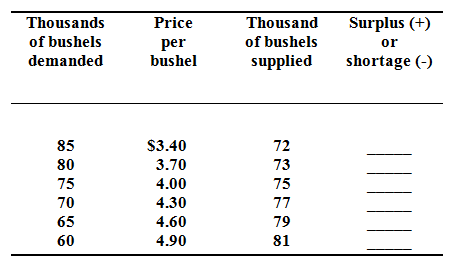
Assume, in the Kansas City grain market, total demands for wheat and the net supply of wheat per month are illustrates here:
2040_Table for wheat.png

Why will $3.40 in this market not be the equilibrium price?  Why not $4.90? “Surpluses drive prices up; shortages drive them down.”  Do you agree?

Data from top to bottom:  -13; -7; 0; +7; +14; and +21.

   Related Questions in Finance Basics

  • Q : Question related to MPC Normal 0 false

    Normal 0 false false

  • Q : Compare diversifiable and non

    Compare diversifiable and non diversifiable risk. Which do you think is more significant to financial managers within a business firms?Diversifiable risk can be dealt along with by, of course, diversifying. Generally non diversifiable risk is co

  • Q : What can financial institution do for a

    What can a financial institution frequently do for a deficit economic unit (DEU) which it would have complexity doing for itself if the DEU were to deal directly with an SEU?SEUs typically desire to supply a small amount of funds, while DEUs typ

  • Q : What is Debt Service Debt Service : The

    Debt Service: The amount (sum) of money needed to pay interest on exceptional bonds and the principal of maturing bonds.

  • Q : Define Augmentation Augmentation : An

    Augmentation: An authorized raise to a formerly authorized appropriation or allotment. This augment can be authorized by the Budget Act provisional language, control sections, or other legislation. Generally a Budget Revision or an Ex

  • Q : Describe how firm search optimal level

    Describe how a firm find out the optimal level of current assets. The optimal level of working capital is finding out by determining the amount that balances the requirement for liquidity and for profitability.

  • Q : Explain the investment opportunity

    Explain the investment opportunity schedule (IOS)? How does it help financial managers take business decisions? The investment opportunity schedule illustrates graphically proposed capital budgeting projects depicting the IRR and dollar amount

  • Q : Describes why reserves are an asset to

    Normal 0 false false

  • Q : Correlate each to the New Economy

    Normal 0 false false

  • Q : Define One-Time Cost One-Time Cost : A

    One-Time Cost: A proposed or real expenditure that is non-recurring (generally only in one annual budget) and not permanently comprised in baseline expenditures. The departments make baseline adjustments to eradicate prior year one-time costs and suit