--%>

Supply of labor by increase in wages rate

If the wage rate increases from $25 per hour to $40 per hour, in that case the elasticity of the supply of labor from this worker is roughly: (i) zero. (ii) 7/15. (iii) 13/15. (iv) one. (v) minus 13/15.
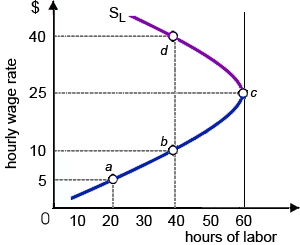
837_Problem on Supply of Labor.png

I need a good answer on the topic of Economics problems. Please give me your suggestion for the same by using above options.

   Related Questions in Managerial Economics

  • Q : Illustrates the conditions of price

    Illustrates the conditions of price discrimination?

  • Q : Substitution Effect within Supply of

    When wage rates rise above $25 per hour in this figure given below, in that case the: (1) worker works more diligently to ensure that she keeps her job. (2) employer pays an excessively high efficiency wage. (3) income effect exceeds the substitution

  • Q : Economic Efficiency to make one person

    When an economic alteration makes one person better off whereas no one else is affected, then this is: (w) efficient to make the change. (x) traumatic to make the change. (y) neither good nor bad for society. (z) strictly a positive value judgment to

  • Q : Limitations of Marginal Costing Write

    Write down the limitations of Marginal Costing?

  • Q : Decline in equilibrium marginal revenue

    Declines within the equilibrium marginal revenue product of a firm’s workers are probably to follow the adjustments to: (1) increases in specific training. (2) decreases in the wage rate. (3) increases in the demand for output. (4) hikes in the

  • Q : Concept of marginal costing In what

    In what condition the concept of marginal costing basically applied?

  • Q : Illustrates the term Demand Function

    Illustrates the term Demand Function?

  • Q : Unexpected increases in national income

    A firm is probably to reduce the number of workers this employs when there are: (i) reductions in the wage rate. (ii) increases in the price of the output. (iii) accumulations of specific training from workers. (iv) technological advances which encourage automation. (

  • Q : Value of Marginal Product of Labor The

    The social value of the extra output by additional units of labor is: (1) marginal revenue product of labor. (2) price of labor. (3) average revenue product of labor. (4) value of the marginal product of labor. (5) marginal resource cost of labor.

    Q : Human Capital and Wage Differentials in

    If compared along with average high school graduates, in that case average Americans along with college degrees: (1) uniformly earn more at every point over their whole lives. (2) earn more primarily early throughout their careers. (3) earn more, but only later during