--%>

Supply of Labor

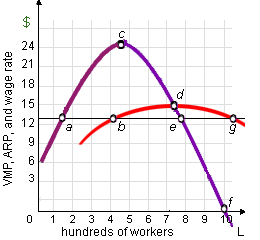
The firm in this illustrated graph is clearly: (1) price taker in the sale of its output because of the shapes of the VMP and MRP curves. (2) price taker in the purchase of labor when this can hire as several workers as this chooses at roughly of $13 per hour. (3) monopsonist since it should increase the wage rate to hire more labor. (4) monopolist since it should cut the price of its output to sell more product (5) polygamist.+
1546_Problem on Demand for Labor.png

How can I solve my Economics problem? Please suggest me the correct answer.

   Related Questions in Managerial Economics

  • Q : Diminish demand for labor A firm's

    A firm's demand for labor would decrease when the: (1) price of the output rose. (2) labor supply curve shifted outward. (3) price of capital rose. (4) wage rate rose. (5) productivity of all workers fell. I need a

  • Q : Diminishing Marginal Productivity of

    Workers tend to be less productive at the margin like they work along with increasingly huge amounts of: (w) physical capital. (x) personal human capital. (y) technology which makes them narrow specialists. (z) labor from other people on an assembly line.

  • Q : Opportunity cost of good Since an

    Since an economy moves downward all along the production possibility frontier which is concave from beneath, the: (1) Opportunity cost of the good whose production goes increasing. (2) Law of rising returns outcomes ever lower costs. (3) Dollar value

  • Q : Explain the meaning of price Explain

    Explain the meaning of price.

  • Q : Unitarily inelastic supply of labor

    Glynn’s supply of labor is unitarily inelastic while the wage rate increases by: (1) $10 per hour to $20 per hour. (2) $10 per hour to $50 per hour. (3) $20 per hour to $50 per hour. (4) $20 per hour to $80 per hour. (5) $80 per hour to $90 per

  • Q : Negative Relationship in Demand for

    The demand curve for labor can be demonstrated as a negative relationship between: (w) the quantity of labor demanded and the wage rate. (x) labor productivity and the quantity of labor used. (y) employment and output. (z) wages and GDP.

  • Q : Credentialism and Occupational Licensing

    Occupational licensing often requires qualifications with small relevance for performance in a specific position before an individual can legally be hired. Artificial and inefficient barriers to the practice of specific occupations, such as dog groome

  • Q : Increment in demand raises the

    An increase within the demand for Swiss cheese will absolutely raise the equilibrium as:  (w) price when the supply of Swiss cheese shrinks over the same period. (x) quantity when the supply of cheese shrinks during the same peri

  • Q : Attributable worth cultivating The

    The theory which the economic rent on agricultural land depends upon how much extra production is gained relative to the production which could be realized on land not rather worth cultivating is attributable to: (1) Johann H. von Thünen. (2) Ada

  • Q : Screening job hiring decisions The

    The concept that employers artificially utilize formal training and education while screening job applicants to make hiring decisions is termed as: (w) nepotism. (x) formalism. (y) human capital discrimination. (z) credentialism.

    Discover Q & A

    Leading Solution Library
    Avail More Than 1438573 Solved problems, classrooms assignments, textbook's solutions, for quick Downloads
    No hassle, Instant Access
    Start Discovering

    18,76,764

    1952485
    Asked

    3,689

    Active Tutors

    1438573

    Questions
    Answered

    Start Excelling in your courses, Ask an Expert and get answers for your homework and assignments!!

    Submit Assignment

    ©TutorsGlobe All rights reserved 2022-2023.