--%>

Substitution effect of wage rate

The substitution effect of a small change within the wage rate dominates the income effect for that worker at each wage rate: (w) exceeding $5 per hour. (x) between $5 per hour and $24.99 per hour. (y) exceeding $25.01 per hour. (z) between $25.01 per hour and $40 per hour.
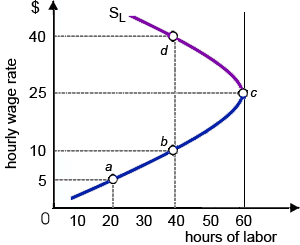
260_Problem on Supply of Labor.png

I need a good answer on the topic of Economics problems. Please give me your suggestion for the same by using above options.

   Related Questions in Managerial Economics

  • Q : Illustrates the conditions of price

    Illustrates the conditions of price discrimination?

  • Q : Analysis of Costs and Revenue with

    Refer to below figure. Assume that the firm is currently producing Q2units. What occurs if this expands output to Q3units: w) Its profit raises by the size of the vertical distance df. x) this makes less profit. y) this incurs a loss. z) this wil

  • Q : Diminishing returns imply economic

    This is not true that the law of diminishing returns which it: (i) Consists applications in numerous areas outside economics. (ii) Is encountered in many ways in economics. (iii) Implies that continually increasing production ultimately entails increa

  • Q : Economic Efficiency to make one person

    While an economic change creates one person worse off without influencing anyone else, this is: (w) good for society. (x) an inefficient change. (y) neither bad nor good for society. (z) strictly a macroeconomic issue.

    Q : Elasticity of Demand for Labor The

    The elasticity of demand for labor is directly associated to: (w) labor’s share of total costs. (x) the elasticity of demand for output. (y) the ease of substitution between labor and other resources. (z) All of the above.

    Q : Wage rate by hiring labor by price taker

    A firm which is a price taker in the labor market will hire labor to the point where the wage rate is equals labor’s: (w) average output. (x) marginal revenue product. (y) average revenue product. (z) marginal physical product.<

  • Q : Labor demand increases and supply

    Wages tend to increase while labor demand: (w) and supply both decrease. (x) decreases and supply increases. (y) and supply both raise. (z) increases and supply decreases. Please choose the right answer from above.

  • Q : States the determinants of elasticity

    States the determinants of elasticity?

  • Q : Elasticity of Demand for Labor in Firm

    Increasing the wage rate increases total wages received through workers when the demand for labor is: (w) relatively elastic. (x) relatively inelastic. (y) unitarily elastic. (z) perfectly elastic.

  • Q : Hiring additional workers exceeds the

    One purpose that firms hire labor at the point where w is equal to P x MPPL is: (1) if w < P x MPPL, the cost (w) of hiring additional workers exceeds the gains (P x MPPL) of hiring them, therefore they would hire fewer workers. (2) when w > P x