--%>

Substantial amounts of currently-laid-off worker

A currently-laid-off worker is probably to find another job quickly when the worker has substantial amounts of: (i) unemployment compensation and a strong union. (ii) specific human capital gained at the previous job. (iii) screening, signaling, and credentialing. (iv) general human capital from previous education and work experience. (v) savings accumulated from past income.
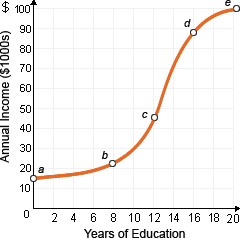
1011_Human Capital problem.png

Hey friends please give your opinion for the problem of Economics that is given above.

   Related Questions in Managerial Economics

  • Q : Forecasting demand what are the

    what are the criteria for good forecasting

  • Q : Diminishing Marginal Productivity of

    Workers tend to be less productive at the margin like they work along with increasingly huge amounts of: (w) physical capital. (x) personal human capital. (y) technology which makes them narrow specialists. (z) labor from other people on an assembly line.

  • Q : Screening job hiring decisions The

    The concept that employers artificially utilize formal training and education while screening job applicants to make hiring decisions is termed as: (w) nepotism. (x) formalism. (y) human capital discrimination. (z) credentialism.

    Q : What are the types of elasticity of

    What are the types of elasticity of demand?

  • Q : When does production take place

    Production takes place while: (w) resources are transformed within inputs. (x) goods are transformed in raw materials. (y) inputs are transformed to create them more valuable. (z) capital depreciates. Please choose

  • Q : What are the certain assumptions in

    What are the certain assumptions in production functions?

  • Q : Competitive Labor Markets Need

    Competitive equilibria in competitive labor markets need: (w) P = MR = AVC. (x) VMP - P is maximized. (y) VMP = MRP = MFC = w. (z) output is at a break-even level. (q) MPP = P. Can anybody suggest me the proper exp

  • Q : Market equlibrium challenges of

    challenges of Equilibrium picing in devloping countries

  • Q : General Training in Human Capital The

    The knowledge regarding local shrubs and trees which Morgan learns whereas working as an apprentice landscaper into the suburbs of a huge city is an illustration of the benefits from: (1) dirty work. (2) general training. (3) dues-paying. (4) high-skilled employment.

  • Q : Concavity in production possibilities

    Concavity (or bowed-out shapes) in production possibilities frontiers is described least fine by: (i) The law of diminishing returns. (ii) Resources being unevenly suited for various forms of production. (iii) Rising opportunity costs. (iv) Non-neutra