--%>

Standard economic reasoning for price elasticity of demand

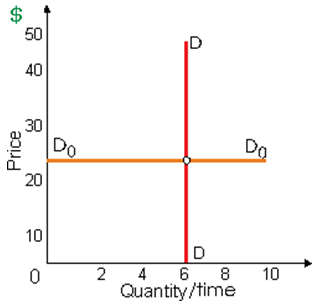
In the given figure as in below, demand curve D0D0: (w) has price elasticity of infinity. (x) is possibly for a luxury good. (y) is unitarily price elastic. (z) seems contrary to standard economic reasoning.
627_Price Elasticity of Demand1.png

How can I solve my Economics problem? Please suggest me the correct answer.

   Related Questions in Microeconomics

  • Q : Formally effective a cartel To form and

    To form and effectively keep a cartel over time needs that the: (w) bulk of output be produced and sold by a minute number of cartel members. (x) product be relatively heterogeneous. (y) demand for the product be highly elastic. (z) government totall

  • Q : Profit-maximizing decision to operate

    Babble-On maintains world-wide patents for software which translates any of three-hundred-thirteen spoken languages within text, along with automatic audio and text translations within any of the other three-hundred-thirteen languages. Babble-On's profit-maxim

  • Q : Market power as a price maker The only

    The only firm in this figure which has market power as a price maker is: (w) Firm A. (x) Firm B. (y) Firm C. (z) Firm D.

    Q : Total variable costs of

    This profit-maximizing competitive firm’s total variable costs or TVC as in illustrated figure can be computed area as: (i) 0P3fq4. (ii) P2P1de. (iii) P3P2ef. (iv) 0P2eq4. (v) aced.

    Q : Interest rate in Determinants of Demand

    The demand curves for most of the nondurable consumer goods would be least influenced by modifications in: (i) Interest rates. (ii) House-hold income. (iii) Prices for related goods. (iv) Tastes and preferences. Ca

  • Q : Sticky prices in oligopoly markets

    Sticky prices within oligopoly markets are: (w) predicted by the kinked demand curve model. (x) substantiated by many statistical studies. (y) most common for highly differentiated products. (z) a result of price discrimination.

    Q : Effect of purchasing goods to

    Most of the people can’t modify relative market prices however have a little control over the relative subjective prices of the goods they consume. They are most probable to make market prices and subjective prices compatible when they: (i) Raise purchases of go

  • Q : Present Value of an Asset The present

    The present value of an asset refers to the: (w) consumer surplus derived from the asset throughout the current period. (x) value today of any expected income payments related with owning the asset. (y) economic rent realized after paying the market p

  • Q : Effects of high probability of

    Since of the high probability of bankruptcy and default of a latest corporation, new corporations: (i) Encompass little trouble selling bonds. (ii) Would prefer to the issue stock. (iii) Encompass more trouble selling bonds than the established corporations. (iv) Woul

  • Q : Price and output combination by demand

    Not like a purely competitive firm, here a profit-maximizing monopolist can: (w) charge any price it finds advantageous and be assured of selling all this produces. (x) select a price and output combination by a downward-sloping demand curve. (y) spen