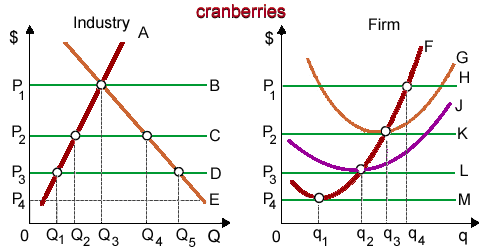
Short-run shut-down point for profits and losses
Short-run shut-down point of the cranberry farm occurs at a price of: (i) P1. (ii) P2. (iii) P3. (iv) P4. (v) Not computable from these figures. Hello guys I want your advice. Please recommend some views for above Economics problems.
Short-run shut-down point of the cranberry farm occurs at a price of: (i) P1. (ii) P2. (iii) P3. (iv) P4. (v) Not computable from these figures.
Hello guys I want your advice. Please recommend some views for above Economics problems.
The corollary of the law of equal marginal benefit is the principle of: (1) Equal marginal utilities per dollar. (2) Diminishing marginal utility. (3) Income injection. (4) Substitution in demand. (5) Diminishing returns. Can someo
When the interest rate is 5 percent and a financial investment produces annual payments of $50,000, in that case the present value of this asset is as: (w) $1,000,000. (x) $5,000,000. (y) $500,000. (z) $10,000,000.
Price elasticities of demand tend to as: (i) fall as higher prices are charged. (ii) rise as higher prices are charged. (iii) almost always be constant. (iv) not be associated to the length of time. (v) not be influenced by price changes.
Can someone please help me in determining the right answer from the following question. The production possibilities frontier is a graphical device exhibiting the: (i) Alternative allocation methods accessible to society. (ii) Combinations of goods wh
Monopolistic competitive firms face: (w) perfectly elastic demand curves. (x) perfectly inelastic demand curves. (y) downward sloping demand curves. (z) the industry demand curves. Hello guys I want your advice. Pl
How much loss can an industry bear? Answer: An industry can bear losses up to its total fixed costs.
Give me answer of this question. Which one of the following is presently a major deterrent to bank panics in the United States? A) the legal reserve requirement B) the fractional reserve system C) the gold standard D) deposit insurance
Can someone help me in finding out the precise answer from the given options. A raise in the cost of resource inputs would lead to the: (1) Shift of the supply curve to right. (2) Shift of the supply curve to left. (3) Movement upward all along the su
For normal goods which experience price changes, then the income effect: (i) Recognizes how higher money income influences demands for goods. (ii) Invalidates the diminishing marginal utility law. (iii) Offsets the substitution effect. (iv) Reinforces the substitution
This is untrue that a firm which is a pure monopoly: (1) commonly engages in extensive advertising to differentiate its products. (2) produces a level of output which is closer to socially optimal when this price discriminates. (3) is the sole produce
18,76,764
1959624 Asked
3,689
Active Tutors
1414355
Questions Answered
Start Excelling in your courses, Ask an Expert and get answers for your homework and assignments!!