--%>

Short run operations of a profit-maximizing pure competitor

This figure in below is demonstrates the operations of a profit-maximizing pure competitor into the: (1) market period. (2) short run. (3) long run. (4) super long run since this can alter technology. (5) shutdown range of production.
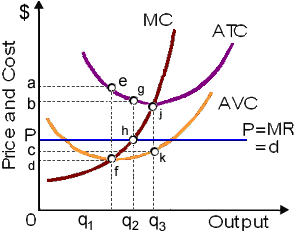
1627_profit-maximizing.png

Hey friends please give your opinion for the problem of Economics that is given above.

   Related Questions in Microeconomics

  • Q : Negative income tax programs Negative

    Negative income tax programs attack poverty through: (w) levying heavy taxes on the poor to encourage them to work more. (x) providing transfers in kind to low income households. (y) providing cash subsidies to guarantee a minimum income to low income

  • Q : Shifting in market demand curve The

    The expectations which proposed new tariffs will be enacted which will raise the future prices and accessibility of digital cameras will: (1) Not affect the present demand for cameras. (2) Cause consumers to move up all along their market demand curve. (3) Not influen

  • Q : Maximizing utility from consumption of

    Given that a MU of French fries of 35 utils and a MU for serving of potato chips at 25 utils, when their respective prices are $1.50 and $.80, the person who wants to maximize utility from the consumption of both of such goods would consume: (i) The similar amount of

  • Q : Goals of Firm-Standard economic

    Can someone please help me in finding out the precise answer from the following question. The standard economic assumption which firms attempt to maximize the profit: (i) Is the beginning point for most of the economists’ analyses of how to operate firms. (ii) C

  • Q : Income effect of a small change in wage

    The income effect of a small change within wage rate is approximately identical to the substitution consequence for Glynn at: (i) point a. (ii) point b. (ii) point c. (iv) point d. (v) point e.

    Q : Short-run equilibrium of purely

    At the price P1, the given figure of purely competitive cranberry industry is within: (w) long-run equilibrium. (x) short-run equilibrium. (y) market period disequilibrium. (z) short-run disequilibrium. <

  • Q : Investment by profit-maximizing pure

    For such illustrated figure profit-maximizing pure competitor, there area aPed shows: (1) fixed cost (TFC). (2) average fixed cost (AFC). (3) the lowest possible economic loss. (4) maximum economic profits. (5) the rate of return on investment. <

  • Q : Price elasticity of supply while the

    If John Whittler can sell totem poles for $1,800 at all, he markets 60 yearly, but while the price falls to $600 apiece; in that case he is willing to sell only 24 yearly. His price elasticity of supply is: (w) 0.43. (x) 0.86. (y) 1.62. (z) 2.48.

  • Q : Normal accounting profit The only

    The only profit earned within the long run through a purely competitive firm is of: (w) normal accounting profit. (x) offset by short term losses. (y) created by exceptionally astute managers. (z) unrelated to its opportunity costs.

    Q : Controlling political processes to

    Can someone please help me in finding out the precise answer from the following question. John Kenneth Galbraith states that the big corporations: (i) Affects economic activity merely trivially. (ii) Have rigorously curbed the market competition. (iii) Employ resource