--%>

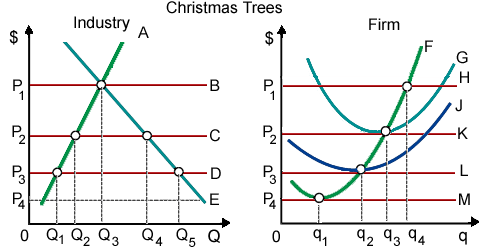
Shifting supply of curve by entry of firms

When the price for Christmas trees is initially P1, in that case in the long run: (w) firms will neither enter nor exit this industry. (x) entry of firms will shift curve supply curve A to the right. (y) exit of firms will shift supply curve A to the left. (z) entry of new firms will shift that firm’s curve F to the right.
1091_supply and demand1.png

Can anybody suggest me the proper explanation for given problem regarding Economics generally?

   Related Questions in Microeconomics

  • Q : Wage differentials-union and nonunion

    I have a problem in economics on Wage differentials-union and nonunion workers. Please help me in the following question. The wage differentials among union and nonunion workers encompass historically averaged roughly: (i) 10% to 15 %. (ii) 5% to 10%.

  • Q : Why demand curve face monopolistically

    Why is demand curve facing a monopolistically competitive firm probable to be very elastic?

  • Q : Determine profit per unit of output

    Price minus average total cost i.e., P - ATC equals: (w) total profit. (x) marginal cost. (y) marginal revenue. (z) profit per unit of output. Please choose the right answer from above...I want you

  • Q : Define Inferior good Inferior good : It

    Inferior good: It is a good for which, other things equivalent, a rise in income leads to a reduction in demand.

  • Q : Standard economic reasoning for price

    In the given figure as in below, demand curve D0D0: (w) has price elasticity of infinity. (x) is possibly for a luxury good. (y) is unitarily price elastic. (z) seems contrary to standard economic reasoning.

    Q : What is production function Production

    Production function: It is the technological relationship among input and output of a firm and is termed as production function.

  • Q : Problem on Normal and Inferior Goods

    Lobster is a normal good and peanut butter is a poorer good. When your income increases, you will most likely consume: (1) More of both the goods. (2) More lobster and less peanut butter. (3) More peanut butter and less lobster. (4) Less of both goods.

    Q : Income elasticity of demand The income

    The income elasticity of demand for mass transit of 0.6 signifies that the demand for mass transit: (1) Is a requirement. (2) Is a luxury. (3) Will increase at a slower rate than income. (4) Will drop/fall when personal incomes increases average.

  • Q : Goals of the Firm-Maximizing their

    When top executives of the corporation pursue policies which maximize their personal incomes and advantages, the most likely outcome is that: (1) The Corporation will attempt to maximize the net revenue. (2) Stockholders in the corporation will experience the highest

  • Q : Asymmetic Infomation The problem of

    The problem of asymmetric information is that: A. neither health care buyers nor providers are well-informed. B. health care providers are well-informed, but buyers are not. C. the outcomes of many complex medical procedures cannot be predicted. D. insurance companies are well-informed but poli