--%>

Shifting of market problem

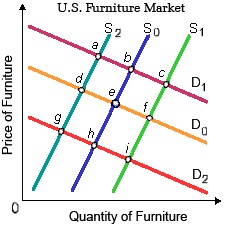
When this market starts in equilibrium at point e on S0D0 and then young American families rousingly “inherit” furniture as their baby-boomer parents shift into smaller retirement homes, then this market will tend to shift in the direction of: (i) point i. (ii) point h. (iii) point a. (iv) point d. (v) point f.
1509_5.jpg

Can someone help me in getting through this problem.

   Related Questions in Macroeconomics

  • Q : From the heterodox approach From the

    From the heterodox approach, what options does the enterprise have to produce more output? What impact do these options have on its cost structure?

  • Q : Type of market when people cannot buy

    Whenever people can’t purchase all of a good they are willing and capable to pay for at present market price, there is surely a market: (1) Price ceiling. (2) Price floor. (3) Shortage. (4) Anomaly.  (5) Surplus. Please

  • Q : Define fiscal policy Define fiscal

    Define fiscal policy? Answer: Fiscal policy is the revenue and expenditure policy of government with a view to combat the state of inflationary or deflationary gap

  • Q : Weighed marginal cost and marginal

    Cite examples of recent decisions that you made in which you, at least implicitly, weighed marginal cost and marginal benefit?

  • Q : Explain Product Market Equilibrium. To

    To begin with, let us recall our three-sector product-market equilibrium model given as C + I + G = C + S + TTo this three-sector model, we now add the foreign trade-the exports (X) and imports

  • Q : How prices allocate resources How

    How prices allocate resources?

  • Q : Price ratios and marginal utility ratios

    I have a problem in economics on Price ratios and marginal utility ratios. Please help me in the following question. The efficiency in consumption needs equality of: (i) Income distribution. (ii) All product price and resources. (iii) MC and MR. (iv)

  • Q : Competitive market What do you mean by

    What do you mean by the term Competitive market?

  • Q : Problem related to rising GDP Between

    Between 1961 and 2007, the rising share of the Canadian population in paid employment contributed to rising GDP per person. But suppose that the share of the Canadian population in paid employment had remained constant between 1961 and 2007. What would Canadian GDP pe

  • Q : Explain the term Macroeconomics

    Macroeconomics is a study of: (1) the economy as an entire or in the aggregate. (2) worldwide economic problems of individual households. (3) interactions among firms and households in one exact market or industry. (4) the rising income inequality wit