--%>

Shift in market equillibrium

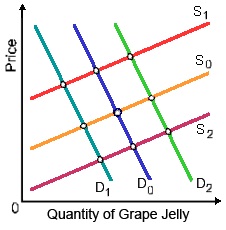
Grape jelly and Peanut butter are strong complements. Assume that severe mold ruined half of this year’s peanut harvest. When the grape jelly market was primarily in equilibrium on S0D0, then this market would shift to: (a) S1D0. (b) S0D2. (c) S2D0. (d) S2D2. (e) S0D1.
136_3.jpg

Give the right answer of the above question.

   Related Questions in Microeconomics

  • Q : Profit Maximization and the Demand for

    Each and every profit-maximizing firm which can cover its variable costs will hire the labor: (1) Just to the point of the diminishing returns. (2) Just to the point where MRP = ARP for the final worker hired. (3) Beyond the point of the diminishing r

  • Q : Maximizes profits when price equal to

    A purely competitive firm will turn out where P = MC since this: (w) is good for society. (x) is all which is permitted through law. (y) maximizes profits. (z) permits price adjustment although not quantity adjustment.

    Q : Wealth and poverty of poor and higher

    Numerous studies have established which, associate to poor families, higher income families onto average have: (w) more children. (x) greater rates of labor force participation. (y) less human capital and more financial capital. (z) greater rates of p

  • Q : Calculating Present Value by Interest

    When all bonds are perpetuities which annually pay $1000 (the sum of one thousand and 00/100 dollars) per annum, at an interest rate of 10 percent, the price of these bonds is: (1) $4000. (2) $5000. (3) $6250. (4) $8000. (5) $10,000.<

  • Q : Pure competition in modern U.S. economy

    Within the modern U.S. economy, there pure competition is: (w) characteristic of all resource markets. (x) rare in product markets. (y) most common for public utilities. (z) strictly regulated throguh government. I

  • Q : Define Marginal rate of Substitution or

    Marginal rate of Substitution (MRS): It is the rate at which a consumer is prepared to give up one good to get the other good.

  • Q : When price of a good or resource drops

    When the price of a good or resource drops/falls, the demands for: (i) that good or resource rise. (ii) Complementary goods or resources reduce. (iii) Replacement of goods or resources reduces. (iv) Luxury goods and inferior resources drop/fall.

  • Q : Price elasticity on straight line curve

    Find out the price elasticity of supply at any point on a straight line curve when A) supply curve intersects ox axis in its negative range B) supply curve intersects ox axis in its positive range. C) Supply curve passes via the origin?

  • Q : Income elasticity of inferior goods

    Negative income elasticities of demand entail those goods are: (1) luxuries. (2) necessities. (3) inferior. (4) substitutes. (5) expensive. Can anybody suggest me the proper explanation for given problem regarding

  • Q : Problem regarding marginal factor cost

    In equilibrium for any of profit-maximizing firm, marginal revenue product of the labor: (i) Is equivalent to the change in net revenue related with selling an extra unit of output. (ii) Surpasses the wage rate by maximum possible. (iii) Equivalents marginal factor co