--%>

Selling price by price elasticity of unitary demand

At the point upon the demand curve for Silver Screen Classic DVDs, here the price elasticity of demand is unitary, the price would be approximately: (i) $10, resulting in roughly 8 million DVDs being sold. (ii) $13, resulting in approximately 6.5 million DVDs being sold. (iii) $16, resulting in about 5 million DVDs being sold. (iv) $20, resulting in around 3 million DVDs being sold. (v) $23.50, resulting in approximately 1million DVDs being sold.
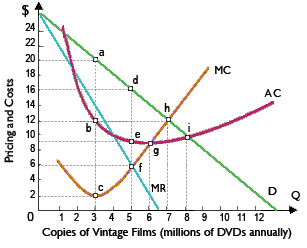
 

1624_maximize profit.png

How can I solve my Economics problem? Please suggest me the correct answer.

   Related Questions in Microeconomics

  • Q : Barriers of entry with oligopoly market

    Barriers of entry tend to be important, and main industries dominated by some huge firms while the market structure is an: (w) monopoly. (x) perfect competition. (y) oligopoly. (z) cartel. Can anybody suggest me th

  • Q : Discrimination problem When racial or

    When racial or personal or sex discrimination decreases worker’s mobility across the occupations: (1) Workers will be completely compensated for their opportunity costs. (2) Economic rent is more probable to be earned by such who are not discriminated against. (

  • Q : Income Distribution and Satisfaction

    Some researchers have determined that citizens of some prosperous countries [for example, Japan] explain themselves as “happy” far less frequently, onto average, than citizens of a few poorer nations [for example, Indonesia]. Nevertheless, almost all studi

  • Q : Adverse Selection in buying a defective

    Whenever an on-line seller deceived you into buying a faulty ‘fully preloaded’ iPod, you encompass lost since of: (1) Moral hazard. (2) Rational ignorance. (3) Adverse selection. (4) Bait-and-switch deception. (5) Cognitive dissonance.

    Q : Screening and Credentialism The critics

    The critics of ‘credentialism’ suppose that firms making employment decisions tend to mainly rely too heavily on: (i) Personal contacts. (ii) Personality testing. (iii) Past experience. (iv) Job interviews. (v) Formal education and trainin

  • Q : Problem on I-Proprietorships The

    The business owned and operated by the lone individual is a/an: (i) Unit of labor. (ii) Entrepreneurship. (iii) Corporation. (iv) Sole proprietorship. Can someone please help me in finding out the accurate answer from the above opt

  • Q : Labor Supply Curves to the Competitive

    The price taker in labor market: (1) Can set the salary that it will pay for the labor it hires. (2) Can set the salary at which it supplies the use of its labor. (3) Doesn’t care what salary it pays or obtains. (4) Can’t influence the wage recognized by t

  • Q : Opportunity costs in different prices

    While a firm is NOT able of price discrimination: (w) various prices are charged for units of remotely related goods. (x) only opportunity costs are reflected in various prices for units of similar good. (y) any short term profit stimulates long run l

  • Q : Ceiling price problem When the

    When the government obliged a ceiling price of P0 on papayas, the market scarcity would correspond to line: (1) ab. (2) cd. (3) ac. (4) bd. (5) ae. </span></p>
                                        </div>
                                        <!-- /comment-box -->
                                    </li>
   
   </td>
	</tr><tr>
		<td>
       
      <li>
                                        <div class=

    Q : Process of Capitalization

    Capitalization is a process which converts: (1) natural resources into economic capital. (2) predictable income flows within wealth. (3) the opportunity cost of capital into the market interest rate. (4) financial capital into economic investment. (5)