--%>

Resource prices

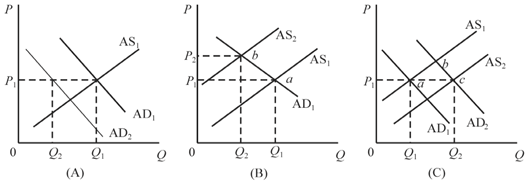
Refer to the following diagrams, in which AD1 and AS1 are the "before" curves and AD2 and AS2 are the "after" curves. Other things equal, a decrease in resource prices is depicted by:1) panel (A) only. 2) panel (B) only. 3) panel (C) only. 4) panels (B) and (C)
 

880_2.png

Help me to go through this problem.

   Related Questions in Microeconomics

  • Q : Relatively price inelastic and consumer

    When demand for a consumer good is relatively price inelastic, in that case the: (i) total spending of consumers will decline when the price rises. (ii) demand curve is linear and vertical. (iii) price of the good is determined through supply alone. (

  • Q : Determine supply curve for perfectly

    Assume that all such curves in below demonstrated graph are infinitely long straight lines. The supply curve which is perfectly price-elastic is: (1) supply curve S1. (2) supply curve S2. (3) supply curve S3. (4) suppl

  • Q : Excess demand for commodity When do we

    When do we state that there is an excess demand for a commodity in the market?

  • Q : Federal government antitrust suit Movie

    Movie producers A, B, and C secretly meet and agree to release their summer blockbuster films in sequence, rather than at the same time. The U.S. Justice Department learns of the agreement and files an antitrust suit. The Federal government would most likely file ch

  • Q : High relative income define by Census

    The Department of the Census defines high relative income as experienced while families: (w) earn more than $60,000 annually per worker in the family. (x) have income which is twice the median incomes of other American families. (y) e

  • Q : Wealth and poverty of poor and higher

    Numerous studies have established which, associate to poor families, higher income families onto average have: (w) more children. (x) greater rates of labor force participation. (y) less human capital and more financial capital. (z) greater rates of p

  • Q : Long-Run Adjustments Since longer time

    Since longer time periods are considered and a bigger range of adjustments (or substitutions) become accessible, demand curves tend to become: (i) Flatter, whereas supply curves become steeper. (ii) Steeper whereas supply curves become flatter. (iii) Flatter, and ther

  • Q : Choosing a statistical Model Choosing a

    Choosing a statistical Model: A number of problems arise in determining whether the work is truly rigorous or not. It is important to determine whether the model chosen makes theoretical and intuitive sense. <

  • Q : Increase profits of quantity selling by

    When a monopolist was selling a quantity which marginal revenue [MR] is greater than marginal costs [marginal costs [MC] in that case this could increase profits by: (w) raising price. (x) increasing output. (y) raisi

  • Q : Example of determining new equilibrium

    As per such supply and demand curves for peanuts, there is the: (w) demand for peanuts has fallen. (x) price rises to P1 due to better peanut technology. (y) production of peanuts was initially Q0. (z) new equilibrium price of pe