--%>

Relevant demand of Kinked Demand by changing in price

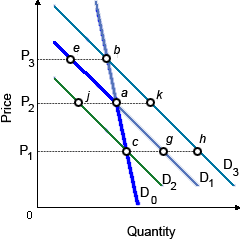
In this demonstrated figure kinked demand curve model, when a firm at point a raises or lowers its price and the rest of the firms in the industry do similar thing, in that case the relevant demand curve for the firm is: (w) demand curve D0. (x) demand curve D1. (y) demand curve D2. (z) demand curve D3.
241_Kinked Demand Curves.png

Can anybody suggest me the proper explanation for given problem regarding Economics generally?

   Related Questions in Microeconomics

  • Q : Elimination of discrimination In the

    In the following diagram, the elimination of discrimination is best depicted by: 1) a move from C to E. 2) an inward shift of the production possibilities curve. 3) a move from A to D. 4) a move from E to C.

    Q : Entry of new firm in monopolistic

    Entry of new firms within a monopolistically competitive market: (1) is preventable. (2) may decrease the established firm’s production costs. (3) increases the established firm’s profits. (4) shrinks demand for a successful firm’s p

  • Q : Elasticity and Revenue At the point of

    At the point of unit elasticity beside the demand curve then a firm faces: (w) profits are always maximized. (x) total revenue is certainly at a maximum. (y) total costs are minimized. (z) All of the above. I need

  • Q : Tax in long run relatively inelastic

    You daily buy author-published books of poetry that are relatively inelastically supplied within the long run. Then government imposes a tax upon books of poetry. Then tax is probable to be borne primarily through: (1) retail book stores. (2) consumer

  • Q : Profit-maximizing firm-perfectly

    The profit-maximizing firm which is perfectly competitive in resource market however that consists of market power in output market will hire labor at the point where: (1) VMP=MRP=MFC>w. (2) VMP>MRP=MFC=w. (3) VMP = MRP = MFC = w. (4) VMP>MRP

  • Q : Absolute value of the proportional

    The absolute value of proportional change within labor hired divided through a proportional change within the wage rate is termed as the: (w) income/substitution coefficient. (x) employment wage response. (y) labor force participation rate. (z) elasti

  • Q : Firms in purely competitive markets

    Firms within purely competitive markets as: (1) practice price discrimination more often than do firms along with market power. (2) do not price discriminate since they are more interested in their customers than are monopolists. (3) cannot price disc

  • Q : Operating competitors with market power

    A firm operating along with a lot of competitors but that still has some control over price is a: (i) pure quantity adjuster. (ii) member of an oligopoly. (iii) purely competitive firm. (iv) firm with some market power. (v) cartel.

  • Q : Occupational Licensing The capability

    The capability of otherwise skilled workers to engage in specific careers or enter some professions is most likely most inhibited by: (1) Occupational licensing. (2) Wage discrimination. (3) Segregation in school system. (4) Signaling and screening. (5) Union labor co

  • Q : Liabilities for damages and penalties

    Can someone please help me in finding out the accurate answer from the following question. The Caveat venditor is an ancient legal doctrine which encourages: (i) Consumer exploitation. (ii) a ‘buyers beware’ approach. (iii) Enforcement of the seller’