--%>

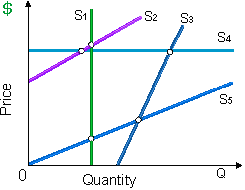
Relatively price inelastic for prices and quantities

Suppose that all these illustrated curves are infinitely long straight lines. Then supply curve which is relatively (although not perfectly) price inelastic for all prices and quantities is: (1) supply curve S1. (2) supply curve S2. (3) supply curve S3. (4) supply curve S4. (5) supply curve S5.
131_Price Elasticity of Supply1.png

Can someone explain/help me with best solution about problem of Economics...

   Related Questions in Microeconomics

  • Q : Proportion of total costs I have a

    I have a problem in economics on Proportion of total costs. Please help me in the following question. Demand for the labor is more elastic as the: (1) Bigger labor costs is as proportion of net costs. (2) Shorter the time-interval considered. (3) Bigg

  • Q : Distribution of income in a purely

    For a specified distribution of income within a purely competitive economy, marginal social benefit will the same marginal social cost unless: (w) “hit and run” entrepreneurs prosper. (x) economic profits

  • Q : Price inelastic demand without

    A monopolist, who does not price discriminate, cannot maximize profits through producing where demand is: (w) price elastic. (x) price inelastic. (y) above marginal cost. (z) above marginal revenue. Hey friends ple

  • Q : Rate of return on financial investment

    When you can buy a bond today for $1,000 and this will mature at $1,210 two years from currently, the rate of return on this financial investment is: (1) 10%. (2) 10.5%. (3) 11%. (4) 12%. (5) 21%.

    Q : Deter entry from potential competitors

    A firm along with important market power which builds an additional plant to increase excess capacity may be trying to as: (w) ignore a depletion of inventory. (x) deter entry from potential competitors. (y) increase demand and thus raise price and pr

  • Q : Long run for production theory Long run

    Long run for the production theory is a time period across which: (i) All production occurs. (ii) Firms can adjust all their costs and resources. (iii) Bigger firms absorb the smaller firms. (iv) Marginal costs become decreasingly significant. (iv) Im

  • Q : Alfred Marshall categorization of

    If Alfred Marshall categorized the analytical periods of time, he supposed that in short run it is: (i) Not possible to vary technology and at least one resource is fixed and hence at least one kind of cost is as well fixed. (ii) Possible to move the resources from on

  • Q : Riskiness of an Investment When the

    When the riskiness of an investment into an apartment complex warrants a 12.5% annual rate of return and the complicated is expected to generate net cash flow (as after utilities, preservation and other costs) of $2 million per year,

  • Q : Perfectly competitive monopolized

    When a perfectly competitive industry is monopolized along with no effect on costs in that case the result will be: (w) higher prices and greater output. (x) lower prices and greater output. (y) higher prices and lower output. (z) lower prices and low

  • Q : Change in supply of good and in price

    When a change in the supply of a good causes a percentage change within price which exceeds in absolute value the resulting percentage change within quantity demanded, then demand is relatively: (1) price elastic. (2) inferior. (3) no