--%>

Relatively price inelastic demand

For Cournot’s Spring Water the demand is relatively price inelastic at: (i) point a. (ii) point b. (iii) point c (iv) point d. (v) point e.
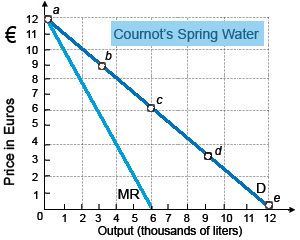
994_Elasticity and Total Revenue.png

I need a good answer on the topic of Economics problems. Please give me your suggestion for the same by using above options.

   Related Questions in Microeconomics

  • Q : Help The problem of asymmetric

    The problem of asymmetric information is that: a) neither health care buyers nor providers are well-informed. b) health care providers are well-informed, but buyers are not. c) the outcomes of many complex medical procedures cannot be predicted. d) insurance companies are well-informed

  • Q : Kinked demand curves and sticky prices

    Sticky prices within oligopoly markets are: (w) predicted by the kinked demand curve model. (x) substantiated by many statistical studies. (y) most common for highly differentiated products. (z) a result of price discrimination.

    Q : Normal market supply curves I have a

    I have a problem in economics on Normal market supply curves. Please help me in the following question. The actuality that normal market supply curves slope upward is most obviously due to: (i) The lower costs incurred as production rises. (ii) Overti

  • Q : Rental Values of Property Rental values

    Rental values of property to a firm are POSITIVELY associated to the: (w) transactions costs incurred through the customers of the firm. (x) transportation costs of the firm’s resource suppliers. (y) physical characteristics which contribute to

  • Q : Morphological attribute After the

    After the morula phase what is the subsequent stage? What is the morphological attribute which defines this phase?

  • Q : Define excess demand Excess demand : If

    Excess demand: If AD > AS at the full employment level. Then it is termed as Excess demand.

  • Q : Buying on margin What does “ buying on

    What does “buying on margin” means?

  • Q : Intermediaries earn income to help

    In the long run within a market system, all intermediaries earn income only when they help sellers and buyers: (w) raise surpluses. (x) by innovating new products. (y) reduce transaction costs. (z) ga

  • Q : Supply of bonds for demand for loanable

    An increase in the supply of bonds tends to: (1) reduce the interest rate. (2) occur simultaneously with an increase in the demand for loanable funds. (3) yield an increase gross investment but a decrease in net investment. (4) drive up the prices of

  • Q : Problem based on type of economy Tell

    Tell me the answer of this question. Economists would describe the U.S. automobile industry as: A) purely competitive. B) an oligopoly. C) monopolistically competitive. D) a pure monopoly.