--%>

Reduce total revenue when demand is elastic

Boosting the price for Pixie’s cheesy fried grits by P2 to P3 will: (w) increases total revenue since demand within inelastic. (x) increase total revenue since demand is elastic. (y) reduce total revenue since demand is inelastic. (z) reduce total revenue since demand is elastic.
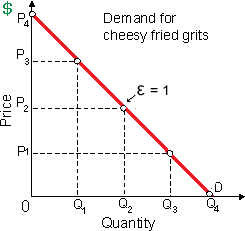
1681_Price Elasticity of Demand5.png

Hello guys I want your advice. Please recommend some views for above Economics problems.

   Related Questions in Microeconomics

  • Q : Annual total revenue of production When

    When Prohibition Corporation maximizes profit in its production of St. Valentine’s Day software, so annual total revenue of it will be around: (1) $140 million. (2) $250 million. (3) $320 million. (4) $420 million. (5) $1 billio

  • Q : Featherbedding-Carpenter union problem

    The carpenters union is capable to force agreement by the furniture manufacturer in Loblolly, North Carolina which the plant hire at least one carpenter per machine to ensure performance at such stations is proficient. This now outlawed strategy is termed as: (i) Feat

  • Q : Fixed input in short run I have a

    I have a problem in economics on fixed input in short run. Please help me in the following question. Which of the given below is most likely to be the fixed input in short run for General Motors? (i) An assembly line worker. (ii) Paint for cars. (iii)

  • Q : Demand perfectly price elastic

    Demand is perfectly price elastic when the price for Pixie's cheesy fried grits is a mostly unmeasurably small bit below the: (1) zero. (2) P1. (3) P2. (4) P3. (5) P4.

    Q : Shifting of left to right demand curve

    Shifting from left to right all along demand curve D, the price elasticity of demand for Pixie’s cheesy fried grits will be: (i) Positive, then unitary, and then negative. (ii) Constant and equivalent to one. (iii) More at high prices than at low prices. (iv) Lo

  • Q : Marginal revenue product problem

    Siberian Software vends custom programs to the multinational corporations. Its programs are coded in a remote region. In equilibrium, the Siberian’s programmers produce a marginal revenue product equivalent to around: (i) $21 per hour. (ii) $25 per hour. (iii) $

  • Q : Total variable cost By refering the

    By refering the following data give the answer of this question . The total variable cost of producing 5 units is: A) $61. B) $48.  C) $37. D) $24. </span

  • Q : Increase total revenue at a diminishing

    When a monopolist increases output along with elastic demand, then total revenue: (w) increases at a constant rate. (x) increases at an increasing rate. (y) increases at a diminishing rate. (z) All of the above are possible.

  • Q : Lower costs of large oligopolists This

    This is possible that consumers could pay a lower price within an oligopoly market than a competitive market since large oligopolists: (w) can price below cost. (x) often give quantity discounts to loyal customers. (y

  • Q : C why cotton textile tndustry is a

    why cotton textile tndustry is a microeconomic study