--%>

Question related to Monopoly

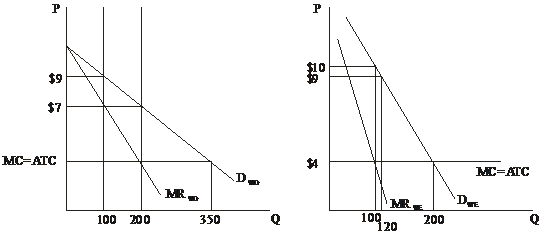
Refer to the following figure . Assume the graphs represent the demand for use of a local golf course for which there is no significant competition (it has a local monopoly); P indicates the price of a round of golf; Q is the quantity of rounds "sold" each day. If the left graph depictes the demand during weekdays, and the right graph the weekend demand, this profit-maximizing golf course will earn how much economic profit over the course of a full seven-day week? A) $4200 B) $3700 C) $3400 D) $2700
2383_hgfdds.png

   Related Questions in Microeconomics

  • Q : Declining cost structure by natural

    Natural barriers to entry within a market arise primarily by: (w) strategies by existing firms to discourage the entry of new firms. (x) perfectly inelastic demands for products. (y) the declining cost structure inherent in producing certain goods. (z

  • Q : Profits and losses in long run In the

    In the long run: (i) purely competitive firms make zero economic profits. (ii) monopolistically competitive firms make zero economic profits. (iii) effective barriers to entry may permit economic profits. (iv) oligopolists and monopolists may realize

  • Q : Constant cost industry with no barriers

    When consumers eventually cannot distinguish one roasted chicken dinner from other, while roasted chicken dinners are produced into a constant cost industry, and when no barriers to entry or exit exist, so this firm’s lo

  • Q : Wage Differentials-occupational crowding

    The Disadvantaged groups have historically been pressured in the direction of low wage jobs in a process termed as: (i) Occupational crowding. (ii) Labor staggering. (iii) Systemic discrimination. (iv) Reverse favoritism. (v) Nepotism.

    Q : Goals of the Firm-Profit Maximization

    The supposition that firms try to maximize the profits: (i) Is the beginning point for most of the economic analyses of how firms function. (ii) Can be wrong for the cases in which the professional corporate managers maximize their own self interests rather than the i

  • Q : Changes in market prices and conditions

    The model of pure competitive is intended to produce insights within how: (w) asymmetric information influences the efficiency of exchange. (x) buyers and sellers negotiate to reach contracts for goods and services. (y) markets determine equitable dis

  • Q : Micro-macroeconomics in allocative

    Economic questions involving both microeconomics and macroeconomics would take in the effects on allocative efficiency and economic development of: (i) War within the Middle East and skyrocketing international prices

  • Q : Maximize profit or minimizes losses

    Assume that a monopolist faces a demand curve that is higher at several output levels than is the firm’s average variable cost curve. Therefore the firm will generate where MR is equal to MC to maximize: (w) total revenue. (x) consumer surplus.

  • Q : Explanation of Substitution Effect The

    The substitution effect helps most in describing why: (1) Demand curves slope down. (2) Goods are either complements or substitutes. (3) Air travel costs less than by walking the cross country. (4) Uncertainty regarding quality justifies govt. control

  • Q : Change in total revenue by market power

    When a monopolist raises price, it: (w) always increases its revenue. (x) always reduces its revenues. (y) doesn't influence its revenue. (z) may increase, decrease, or not change total revenue. I need a good answe