--%>

Question on level of free market wage rate and employment

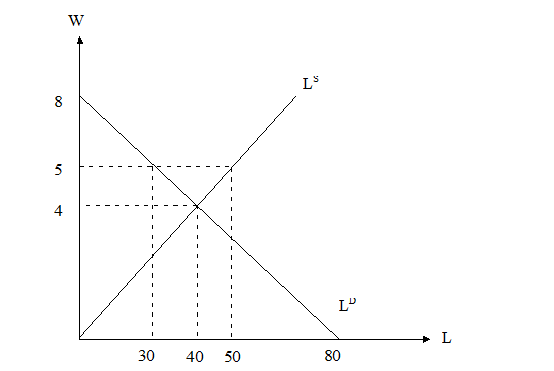
In the year of 1996, the U.S. Congress raised the minimum wage from $4.25 per hour to $5.15 per hour. Some of the people suggested that a government subsidy could help employers finance the higher wage. Assume the supply of low-skilled labour is specified by

                                                                          LS= 10w

where LS is the quantity of low-skilled labour (in millions of persons employed each year) and w is the wage rate (in dollars per hour). The demand for labour is specified by
                                                             LD =80-10w

What will be the level of free market wage rate & employment? Assume the government sets a minimum wage of $5 per hour. How many people would be employed then?
In a free-market equilibrium, LS = LD. Solving out yields w = $4 and LS = LD = 40. If the minimum wage is $5, then LS = 50 and LD = 30. The number of people employed will be specified by the labour demand, thus employers will hire 30 million workers.
2011_ans 12.png


   Related Questions in Finance Basics

  • Q : Effect of merger activity in the

    How has the merger activity in the past decade influenced the concentration of assets in the banking industry? Over the last decade, the number of commercial banks declined through twenty-one percent and the averag

  • Q : Financial crisis during 1997-1998

    Describe the Financial crisis during the time period of 1997-1998 ?

  • Q : What is Prior Year Adjustment Prior

    Prior Year Adjustment: An adjustment for the difference among prior year accruals and real expenditures or revenues. The previous year adjustment amount is usually comprised in the Fund Condition Statements as an adjustment to realign the starting fun

  • Q : Describe benefits of collecting early

    Describe benefits of "collecting early" and how do companies effort to do this? Money contains time value. The sooner cash is gathered, the better. Companies employ regional collection centres and lock boxes to facilitate this.

  • Q : Explain Unscheduled Reimbursements

    Unscheduled Reimbursements: The Reimbursements collected by an agency which were not budgeted and are accounted for by an individual reimbursement class of an appropriation. To expend unscheduled reimbursements, the budget revision sh

  • Q : Define General Fund General Fund (GF):

    General Fund (GF): For lawful basis accounting and budgeting aims, the predominant fund for the financing state government programs, employed to account for revenues that are not particularly designated to be accounted for by another fund. The main so

  • Q : Explain Category Transfer Category

    Category Transfer: It is a permitted transfer between categories or functions within the similar schedule of an appropriation. These transfers are currently authorized by Control Section 26.00 of the Budget Act (and proceeding to 1996-97, by Section 6

  • Q : Define the term Program Cost Accounting

    Program Cost Accounting (PCA): The level of accounting which identifies costs by activities executed in achievement of a purpose in contrast to the traditional line-item format. The aim of accounting at this level is to generate cost data adequately a

  • Q : Government requirements imposed on

    Describe some of the government requirements imposed onto a public corporation which are not imposed on a private, intimately held corporation? Public corporations ought to submit audited financial statements to the government for release to the

  • Q : Explain Statewide Cost Allocation Plan

    Statewide Cost Allocation Plan (SWCAP): It is the amount of state administrative, General Fund costs (example, amounts expended by the central service departments like the State Personnel Board, State Treasurer’s Office, State C