Question on hypothetical economy
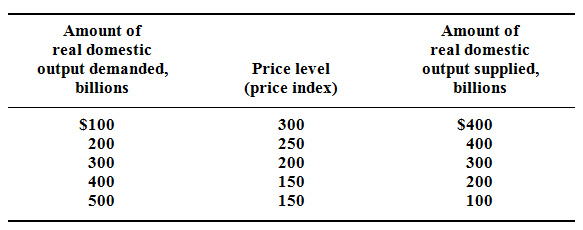
Consider that aggregate demand and the short run supply for any hypothetical economy are as : Why will a price level of 150 not be an equilibrium price level in this economy? Why not 250?
Consider that aggregate demand and the short run supply for any hypothetical economy are as :
Why will a price level of 150 not be an equilibrium price level in this economy? Why not 250?
Expert
At price level of 150, real GDP supplied maximum is $200 billion, less than the real GDP demanded of $400 billion. The shortage of real output will drive the price level up. At price level of 250, real GDP supplied is $400 billion that is more than the real GDP demanded of $200 billion. The surplus of real output will drive down the price level. Equilibrium takes place at the price level at which AS & AD intersect.
Describe the advantages and disadvantages of the aggressive working capital financing approach? An aggressive working capital financing approach generally results in a lower cost of funds for a firm however a higher level of risk.
Unscheduled Reimbursements: The Reimbursements collected by an agency which were not budgeted and are accounted for by an individual reimbursement class of an appropriation. To expend unscheduled reimbursements, the budget revision sh
Normal 0 false false
Cite three example of recent decisions which you made in which you, at least implicitly, weighed marginal costs & marginal benefits.
Special Funds: For legal base budgeting purposes, funds produced by statute, or administratively per Government Code Section 13306, employed to budget and account for taxes, licenses, and fees which are restricted by law for specific activities of the
Planning Estimate Line: The separate planning estimate adjustment or entry for a specific expenditure or type.
18,76,764
1925878 Asked
3,689
Active Tutors
1426686
Questions Answered
Start Excelling in your courses, Ask an Expert and get answers for your homework and assignments!!