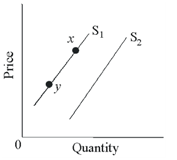
Question on demand and supply
Refer to the following diagram. A decrease in supply is illustrated by a: A) move from point x to point y. B) shift from S1 to S2. C) shift from S2 to S1. D) move from point y to point x.
Assume that D0 is the initial demand curve for land in this demonstrated figure, and a land tax at a rate of t is imposed. Trying by the landlord to pass the tax forward to the renter, which will cause the: (i) supply curve of housing to sh
The law of supply is graphically exhibited by the supply curve which is: (1) Moving all along the demand curve. (2) Vertical. (3) Upward-sloping. (4) Downward-sloping. Can someone please help me in finding out the
The knowledge regarding local trees and shrubs which Morgan learns as working as an apprentice landscaper in suburbs of a big city is an illustration of the advantages from: (i) Dirty work. (ii) Dues-paying. (iii) General training. (iv) High-skilled employment. (v) Sp
You desire to purchase a used car. The dealer knows accurately how well the car works and how much it must cost, although you are not sure of its value. This is an illustration of: (i) Asymmetric information. (ii) Dealer rights. (iii) Predatory pricing. (iv) First mov
When a previously competitive industry becomes monopolized along with no consequence on market demand or the structure of production costs, the effect will be: (w) higher prices and greater output. (x) lower prices and greater output.
Perfectly equal distributions of income or wealth are reflected within the Lorenz curve demonstrated as: (i) line 0A0'. (ii) line 0B0'. (iii) line 0C0'. (iv) line 0D0'. (v) line 0E0'. Q : Equilibrium rent imposing price ceiling When the New York City government only permits landlords to charge $800 a month for a little apartment while equilibrium rent would be $1,500, this has imposed: (w) price floor. (x) regulation which will result in market surpluses. (y) regulation that
When the New York City government only permits landlords to charge $800 a month for a little apartment while equilibrium rent would be $1,500, this has imposed: (w) price floor. (x) regulation which will result in market surpluses. (y) regulation that
Can someone please help me in finding out the accurate answer from the following question. When your marginal utility from $5 movies averages 50 utils and your marginal utility from $2 gallons of the gasoline is 20 utils, you can: (1) Not add to your satisfaction by m
When output is expanded, then a firm's total revenues: (1) are maximized where marginal revenue is zero. (2) decline whenever average revenue falls. (3) rise more quickly the faster marginal returns diminish. (4) are maximized where profit is maximize
A price hike $4 to $5 per slice of pizza because of total revenue to: (w) fall. (x) remain constant. (y) rise. (z) this is not possible to tell from such data. Discover Q & A Leading Solution Library Avail More Than 1413105 Solved problems, classrooms assignments, textbook's solutions, for quick Downloads No hassle, Instant Access Start Discovering 18,76,764 1933201 Asked 3,689 Active Tutors 1413105 Questions Answered Start Excelling in your courses, Ask an Expert and get answers for your homework and assignments!! Submit Assignment
18,76,764
1933201 Asked
3,689
Active Tutors
1413105
Questions Answered
Start Excelling in your courses, Ask an Expert and get answers for your homework and assignments!!