--%>

Purely competitive price takers and quantity adjusters

Different from Firm D, Firms A and B as well as C are all: (w) profitable firms that enjoys significant market power. (x) purely-competitive price-takers and quantity-adjusters. (y) pure monopolies. (z) perfectly inelastic suppliers.
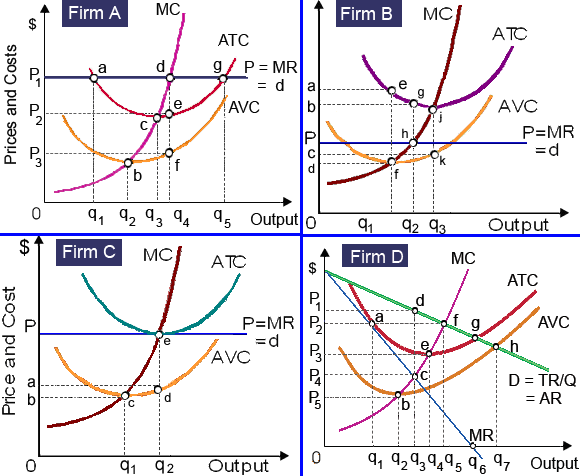
1622_Market Structures.png

Hello guys I want your advice. Please recommend some views for above Economics problems.

   Related Questions in Microeconomics

  • Q : Sole Proprietorships and Partnerships

    Can someone please help me in finding out the precise answer from the following question. Relative to corporations, drawbacks to the owners of sole partnerships and proprietorships comprise:  (i) Unlimited liability. (2) Extreme government regulation. (3) Limited

  • Q : Divide future income by one plus

    To discount income which will be received in one year from the interest rate, we: (w) multiply the future income by the interest rate. (x) divide the future income by the interest rate. (y) divide the future income by (1 + the interes

  • Q : Monopolistic competitive firm in normal

    This monopolistically competitive firm in illustrated figure produces Q units as well as experiences: (1) economic profits equal to 0cbQ. (2) economic losses equal to cpab. (3) more than normal accounting profits. (4) marginal cost in excess of averag

  • Q : Illustration of total revenue and

    The Square-Wheeled Locomotive, the last passenger train to Flatland, Iowa, wants more total revenue. When passengers’ demands for tickets are comparatively price elastic, in that case the railroad must: (1) raise the price, but lower this when d

  • Q : Minimizes losses and maximizes profits

    When Firm B in demonstrated graph successfully minimizes losses and maximizes its profits that have: (1) covered overhead while incurring short-run economic losses. (2) potential economic profit of Pbgh per period. (3) total costs equal to 0phq2. (4)

  • Q : Problem on reducing Complementary Goods

    The failure of spaghetti crop would be most probable to decrease the: (1) Supply of cheap red wine. (2) International rate of inflation. (3) Demand for potato salad. (4) Demand for the spicy tomato sauce. (5) Prices of dinners in an Italian restaurant.

    Q : Public Policy and the Distribution of

    The two policies that most likely account for most of the trend toward greater income equality during 1929 and 1975 are: (w) improved educational opportunities, and tax and transfer policies. (x) reduced sex discrimination and public availability of b

  • Q : Nominal wages If the nominal wages of

    If the nominal wages of carpenters rose by 5 percent in the year of 2000 and the price level increased by 3 percent, then the real wages of carpenters: A) decreased by 2 percent. B) increased by 2 percent. C) increased by 3 percent. D) increased by 8 percent.

  • Q : Absolute and Complete Inequality

    Absolute and complete inequality into the distribution of income or wealth would be reflected within the Lorenz curve demonstrated as: (i) line 0A0'. (ii) line 0B0'. (iii) line 0C0'. (iv) line 0D0'. (v) line 0F0'.

    Q : Features of oligopoly Features of

    Features of oligopoly: Following are some principal features of oligopoly : A) A few firmsB) High degree of interdependence.C) Non-price competition.D) Entry barriers.E) Formation of cartels