--%>

Purely competitive labor market is firstly in equilibrium

When this purely competitive labor market is firstly in equilibrium at D0L, S0L, a move to equilibrium at D1L, S0L would be inconsistent along with increases in: (w) the price of output. (x) labor productivity. (y) workers’ increased willingness to give up leisure for extra income. (z) the numbers of firms in industries hiring labor through this market.
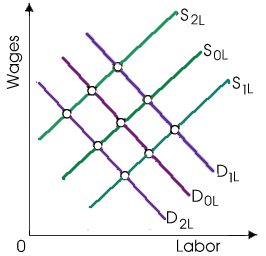
1095_Labor Market Equilibria.png

Hey friends please give your opinion for the problem of Economics that is given above.

   Related Questions in Managerial Economics

  • Q : Marginal Resource Costs and Wage Rates

    For a profit maximizing competitive firm operating within a competitive labor market, therefore the: (w) marginal resource cost of labor is the same to the wage rate. (x) supply of labor is perfectly inelastic. (y) production quota is

  • Q : Supply of certain types of labor The

    The supply of certain types of labor is determined through the: (w) skills of potential workers. (x) the availability of other workers. (y) the prices of output. (z) production technology. I need a good answer on the topic of

  • Q : Equilibrium in purely competitive

    As the labor market within a purely competitive economy is into equilibrium: (1) the marginal benefits by unemployment exceed unemployment compensation. (2) the marginal benefits and marginal costs from employment are equal. (3) econo

  • Q : Very high fixed costs in contestable

    A market is improbable to be contestable when entry needs new firms to incur very high: (w) variable costs. (x) fixed costs. (y) principal-agent problems. (z) marginal costs. I need a good answer on the topic of Economics <

  • Q : Income effect of increase wage When the

    When the income effect of a wage raise is more powerful than the substitution effect, in that case the:  (i) labor supply curve will be “backward bending.” (ii) unemployment rate will rise since more people will be av

  • Q : Wage rate paid for raises labor When

    When the wage rate paid for labor raises, in that case the: (1) supply of labor increases (2) opportunity cost of leisure rises. (3) workers always supply more labor. (4) level of national income increases. (5) opportunity cost of leisure falls.

  • Q : Illustrates the pricing policies briefly

    Illustrates the pricing policies briefly?

  • Q : Investment in Specific Human Capital An

    An investment in specific human capital arises while: (w) Chandra learns Japanese to be eligible for a potential job in Tokyo. (x) Chele has a face lift so she can increase her fees for high-fashion modeling. (y) Chelsea practices playing a harp and a

  • Q : Costs of firm by adding revenue in them

    When the last worker hired adds extra to the firm’s revenue in that case to the firm’s cost: (w) hiring the last worker causes profit to rise. (x) hiring the last worker causes profit to fall. (y) the firm should stop hiring workers. (z) m

  • Q : Income effect of a change in wage rates

    When comparing such labor supplies in this illustrated figure, this is clear that the income effect of a change within wage rates is: (w) positive for Morgan and negative for Chandra. (x) more powerful than the substi