--%>

Purely competitive labor market in equilibrium

When this purely competitive labor market is firstly in equilibrium at D0L , S0L , an increase into labor force participation rates will result within equilibrium being attained at: (w) D0L , S0L . (x) D2L , S1L . (y) D0L , S1L . (z) D1L , S1L .
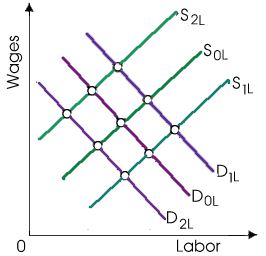
2447_Labor Market Equilibria.png

I need a good answer on the topic of Economics problems. Please give me your suggestion for the same by using above options.

   Related Questions in Managerial Economics

  • Q : Explain important specific functions of

    Explain the important specific functions of material economics?

  • Q : Differentiate between individual and

    Differentiate between individual demand schedule and Market demand schedule in law of demand?

  • Q : Requirement of Screening Boris operates

    Boris operates a local landscaping company, needs each potential employee to lift a 200 pound tree before being hired whole-time. This obligation is an example of: (1) signaling. (2) discrimination. (3) screening. (4) derived demand. (5) automation.

    Q : Requirement of equal paying amounts A

    A requirement of equal pay for workers along with equal amounts of education, responsibility, and experience is termed as the doctrine of: (1) marginal productivity. (2) non-exploitation. (3) central wage planning. (4) comparable wort

  • Q : Explain about cartel in economics A

    A cartel is: (a) an oligopoly model which relies on interdependence. (b) an organization of oligopolist firms behaving like a monopoly. (c) an organization of firms that jointly make decisions. (d) All of the above.

    Q : Price Taker in Labor Supply Curves

    When a firm is a price taker in the labor market, in that case the: (w) wage is constant for any quantity of labor this would hire. (x) marginal resource cost of labor is constant for any quantity of labor this would hire. (y) wage equals the marginal

  • Q : Wealth definition of economics Who is

    Who is the father of economics and what is wealth definition of economics?

  • Q : Moral Hazard and Efficiency Wages

    Firing a worker who regularly goods off and calls in sick may not resolve the moral hazard problem of shirking when: (w) there is a high probability which the worker will sue the firm. (x) the local unemployment rate is high. (y) average worker productivity is low. (z

  • Q : Illustrates the Importance of

    Illustrates the Importance of managerial economics?

  • Q : Define naive method and its techniques

    Define naive method and its techniques briefly.