--%>

Purely competition on the average

This purely competitive brickyard as in below graph on the average experiences an: (w) economic profit of about $135 per day. (x) economic loss of roughly $150 per day. (y) accounting profit of less than $100 per day. (z) accounting loss of more than $100 per day.
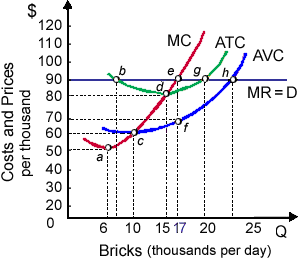
2285_Profit Maximization1.png

Can someone explain/help me with best solution about problem of Economics...

   Related Questions in Microeconomics

  • Q : Define Direct taxes Direct taxes :

    Direct taxes: Whenever the liability to pay tax and the burden of that tax fall on similar person, it is termed as direct tax. Illustrations are: wealth tax, income tax, corporation tax, gift tax and so on.

  • Q : Competitive Prices for selling This

    This purely-competitive producer’s generic bricks presently sell for: (i) $60 per thousand. (ii) $70 per thousand. (iii) $80 per thousand. (iv) $90 per thousand. (v) $100 per thousand.

    Q : Hiring labor for Profit Maximization

    When the marginal revenue product of the very last worker hired is more than the marginal resource cost of the worker, then the firm: (1) Is experiencing rising returns to the scale. (2) Can raise its gains by hiring more labor. (3) Is maximizing the profit. (4) Must

  • Q : Scenario Analysis Based on the recent

    Based on the recent success of Ontario tennis star Milos Raonic, Nike Canada will make new state of the art tennis racket with a red maple leaf on the strings. Mike expects to sell 10,000 rackets yearly for the next 4 years. Each racket will retail at a manufacturer&r

  • Q : Determine profit maximizing price The

    The profit-maximizing price for copyrighted smash-hit St. Valentine’s Day software of Prohibition Corporation is: (i) $12 per copy. (ii) $20 per copy. (iii) $24 per copy. (iv) $32 per copy. (v) $40 per copy. <

  • Q : Characteristics of constant cost

    Characteristics of industries which are not characteristics internal to operations of an individual firm include: (1) potential principal-agent problems. (2) diseconomies of scale. (3) production costs which either increase or decrease like the size of a market not su

  • Q : Variation in demand and supply with

    It shifts within the demand for new textbooks from D0 to D1 may be a result of: (1) increased enrollments of students. (2) consumers' expectations of a future increase within the price of textbooks. (3) increased literacy rates. (4) increasingly efficient E-

  • Q : Shift in demand curve Describe the

    Describe the differences between shifts in demand and movements along the demand curve. What are the main factors which can shift the demand curve? Explain why they cause the demand curve to shift. Use examples and draw graphs to supp

  • Q : Preferance of food after income rises

    Assume that, for you, lobster is an ordinary good and peanut butter is a poorer good. When your income increases, you will probably consume: (1) Greater of both goods. (2) Less of both goods. (3) Greater peanut butter and less lobster. (4) Greater lobster and less pea

  • Q : Outcome of a purely competitive market

    When cost conditions are otherwise identical, compared to the outcome of a purely competitive market, in that case a monopolist: (w) produces less and charges more. (x) maximizes total profits whenever possible. (y) confronts a demand curve where P =