--%>

Profit price by earning in Human capital

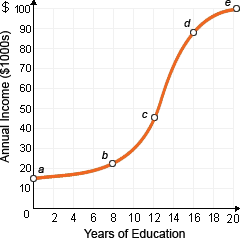
As per demonstrated in this graph, there average college graduate will earn around: (1) $12,000 yearly. (2) $20,000 yearly. (3) $45,000 yearly. (4) $90,000 yearly. (5) $100,000 yearly.
1920_Human Capital problem.png

Please choose the right answer from above...I want your suggestion for the same.

   Related Questions in Managerial Economics

  • Q : Explain the Price Elasticity of Demand

    Explain the Price Elasticity of Demand.

  • Q : Marginal Product of Labor Diminishing

    Diminishing returns to labor or questions of monitoring and coordination start to overwhelm any gains by specialization and division of labor within this graph at: (1) point a. (2) point b. (3) point c. (4) point d (5) point e.

  • Q : Elasticity of supply of labor by

    If the wage rate increases from $10 per hour to $25 per hour, then the elasticity of the supply of labor from this worker is roughly: (1) zero. (2) 7/15. (3) one. (4) minus 8/15.

    Q : Profit price by earning in Human capital

    As per demonstrated in this graph, there average college graduate will earn around: (1) $12,000 yearly. (2) $20,000 yearly. (3) $45,000 yearly. (4) $90,000 yearly. (5) $100,000 yearly.

    Q : Problem on Occupational Crowding After

    After vacationing hundreds of restaurants, then a restaurant critic has concluded which in almost all the workers who clear tables and also wash dishes appear to be illegal aliens by Mexico. The critic has observed a phenomenon termed as: (1) marginalized labor. (2) t

  • Q : Government and Labor Assume that male

    Assume that male nurses are paid more than female nurses for same work. When an “equal pay for equal work” law is enforced and enacted, it may: (w) decrease the wages of male nurses. (x) not influence the wages of female nurses. (y) increa

  • Q : Equal pay for equal work rule Rigid

    Rigid enforcement of “equal-pay-for-equal-work” law would: (w) raise the wage of minority workers who had been discriminated against. (x) lower the wages of “favored” non minority workers who had received higher wages before. (

  • Q : Substitution and Demands for Resources

    When the relative price of a resource decreases, we would usually expect a firm to employ less units of: (w) that resource due to the substitution effect. (x) that resource because of the output effect. (y) complementary resources due to the substitut

  • Q : Explain the infinitely elastic demand

    Explain the infinitely elastic demand.

  • Q : Smoothing techniques or Exponential

    Explain about the term smoothing techniques.